
Practice question, Question 1 of 30
Passing target: 70% (21/30)
The car ahead of you passes a road sign. You start counting "one-thousand-one, one-thousand-two" and reach the same sign before you say "one-thousand-three." What does this tell you?
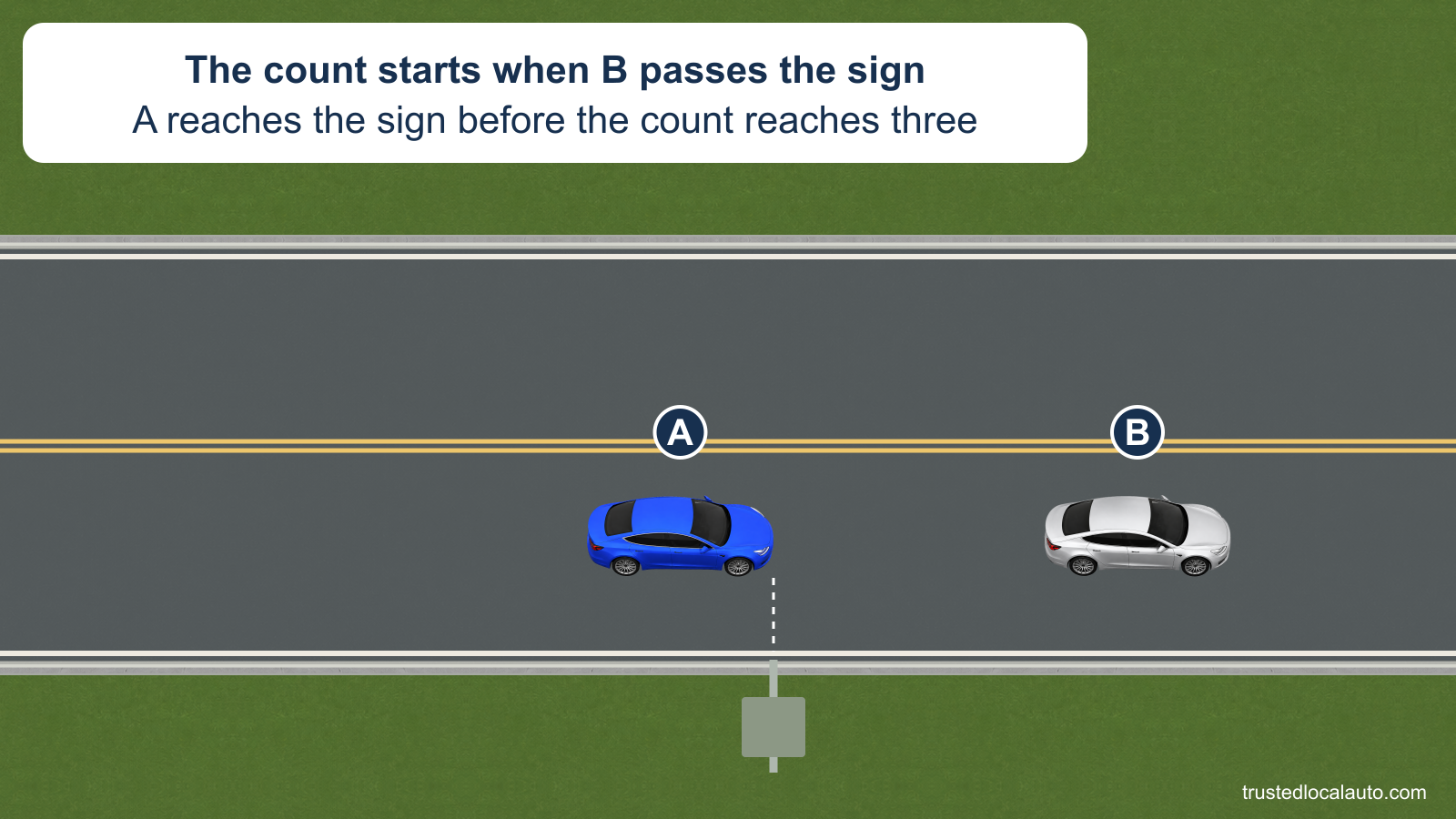
Correct answer: You are too close; drop back and count again until you reach three seconds.
Why
Rear-end crashes are very common, and most happen because the following driver has too little time to stop when the vehicle ahead stops suddenly. Because the count measures time rather than feet, the gap in feet grows by itself as your speed goes up. Some situations call for more room than three seconds, such as following a motorcycle, pulling a trailer or approaching a railroad crossing.
Verified against New Mexico Driver Manual · Following distance (three-second rule) · p. 26, 27
Is this question correct and clear?
Continue learning
Related New Mexico questions
- You are driving through a residential neighborhood in New Mexico, and you have not seen any speed limit sign. What is the maximum speed?
- You plan to move into the next lane. Your inside and side mirrors show that the lane is clear. Where could another vehicle still be hidden from you?
- You drive on a rural county road outside any town or school zone. The county has set a 45 mph limit for this road after a study and state approval, but no speed limit signs are posted yet. What is the maximum speed?
- At dusk on a mountain highway, a deer runs across the road well ahead of you and disappears into the trees. What should you do?
- On a clear, dry day you drive at 35 mph on a highway where traffic moves at the posted 65 mph. There is no minimum-speed sign and no reason to go slowly, and a line of cars is forming behind you. Which statement is correct?
- Rain has made the road slippery, and you are following a pickup truck at highway speed. How much following time does the New Mexico manual suggest?