
Back to New York
New York Class D Permit Practice Test
Full test preview Question 1 of 20
0 answered 20 remaining
Passing target: 70% (14/20)
Traffic Signals & Road MarkingsStandalone practice
You drive on a one-way street with two lanes. A single broken white line separates the lanes, and you want to move into the other lane. When may you cross the line?
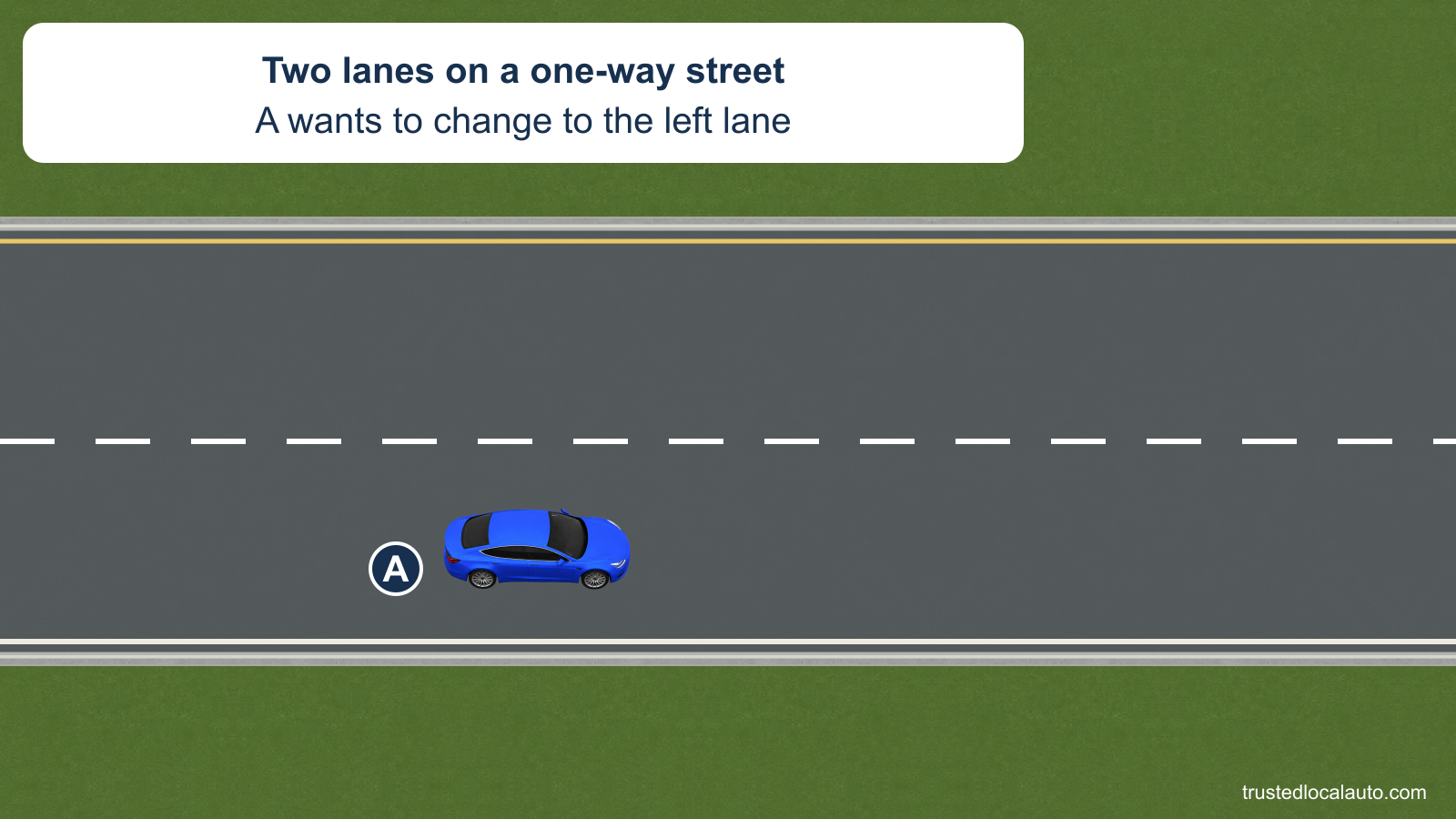
A travels in the right lane of a one-way street. A single broken white line separates it from the empty lane on its left.
Correct answer: When you can move over safely without getting in the way of other traffic.
Why
A broken line gives permission, not a promise that the move is safe. New York law requires you to stay in your lane until you have made sure that the move is safe, and to signal before you move. Check your mirrors and your blind spot, signal, and move only into a clear gap.
Verified against New York State Driver's Manual · Pavement Markings · p. 32
Report a question issueContinue learning
Related N.Y. questions
You drive on a two-lane road with double solid yellow center lines. You want to turn left into a gas station driveway on the other side of the road. What is the rule?It is night on a two-lane rural road. Just before a narrow bridge, the white line at the right edge of your lane starts to slant toward the yellow center line. A large truck is coming from the other direction. What should you do?Late at night, the signal facing you at an intersection is flashing red. A car on the cross street is close to the intersection. What should you do?The signal facing you at an intersection is flashing yellow, and a pedestrian is walking toward the corner ahead. What should you do?You are in a left-turn lane, and a green arrow lets you turn. As you come near the stop line, the green arrow changes to a yellow arrow. What does the yellow arrow tell you?You are first in the left-turn lane. The signal shows a red light and a green left arrow. A pedestrian is still crossing the street that you will turn into. What should you do?