
Practice question, Question 1 of 30
Passing target: 80% (24/30)
Your car breaks down on an interstate in daylight. You steer it well off the road onto the shoulder. Which action does the North Carolina handbook tell you to take?
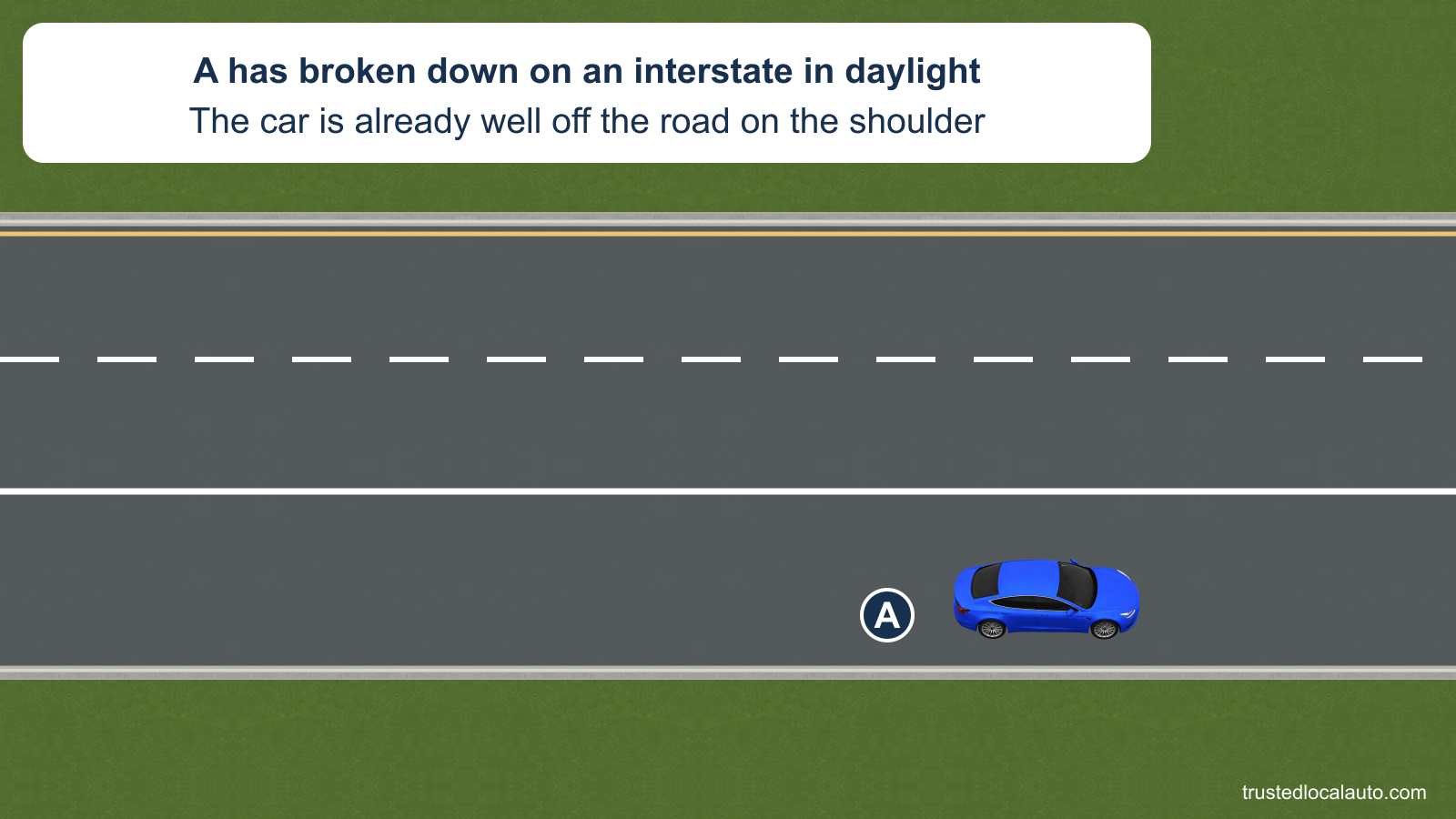
Correct answer: Tie a white cloth to the left door handle or antenna, and raise the hood.
Why
Interstate traffic passes close and fast, so a person in or near a disabled car is at risk. Get everyone out on the passenger side and wait off the road, away from the front and the rear of the car. At night, turn on the emergency flashers or the parking lights; a driver who sees a disabled vehicle should call the State Highway Patrol or local police.
Verified against North Carolina Driver Handbook · Interstate Highways · p. 66, 78
Is this question correct and clear?
Continue learning
Related North Carolina questions
- You enter an interstate acceleration lane at 30 mph. Traffic in the right lane of the interstate moves at about 65 mph, and the speed limit is 70 mph. How should you use the acceleration lane?
- You drive at 65 mph in the right lane of an interstate. Your exit is 1 mile ahead, and a sign shows an exit ramp speed of 35 mph. How should you leave the interstate?
- You are near the end of an interstate acceleration lane. A pickup truck in the right lane of the interstate is beside you, and its driver does not slow down or move over. Under North Carolina law, who must yield?
- You plan a six-hour drive, mostly on interstates. Which plan follows the North Carolina handbook's advice to prevent drowsy driving?
- On interstate and primary highways, North Carolina posts minimum speeds. Which pair of minimum speeds does the handbook give for a 55 mph zone and for a zone of 60 mph or more?
- You drive in the right lane of an interstate and see that you have just passed the exit that you need. What should you do?