
Practice question, Question 1 of 30
Passing target: 80% (24/30)
You drive in the right lane of a six-lane interstate. The speed limit is 70 mph, and no minimum speed sign is posted. Traffic in your lane moves steadily at about 65 mph, and faster cars use the lanes to your left. You do not plan to pass anyone. What speed should you choose?
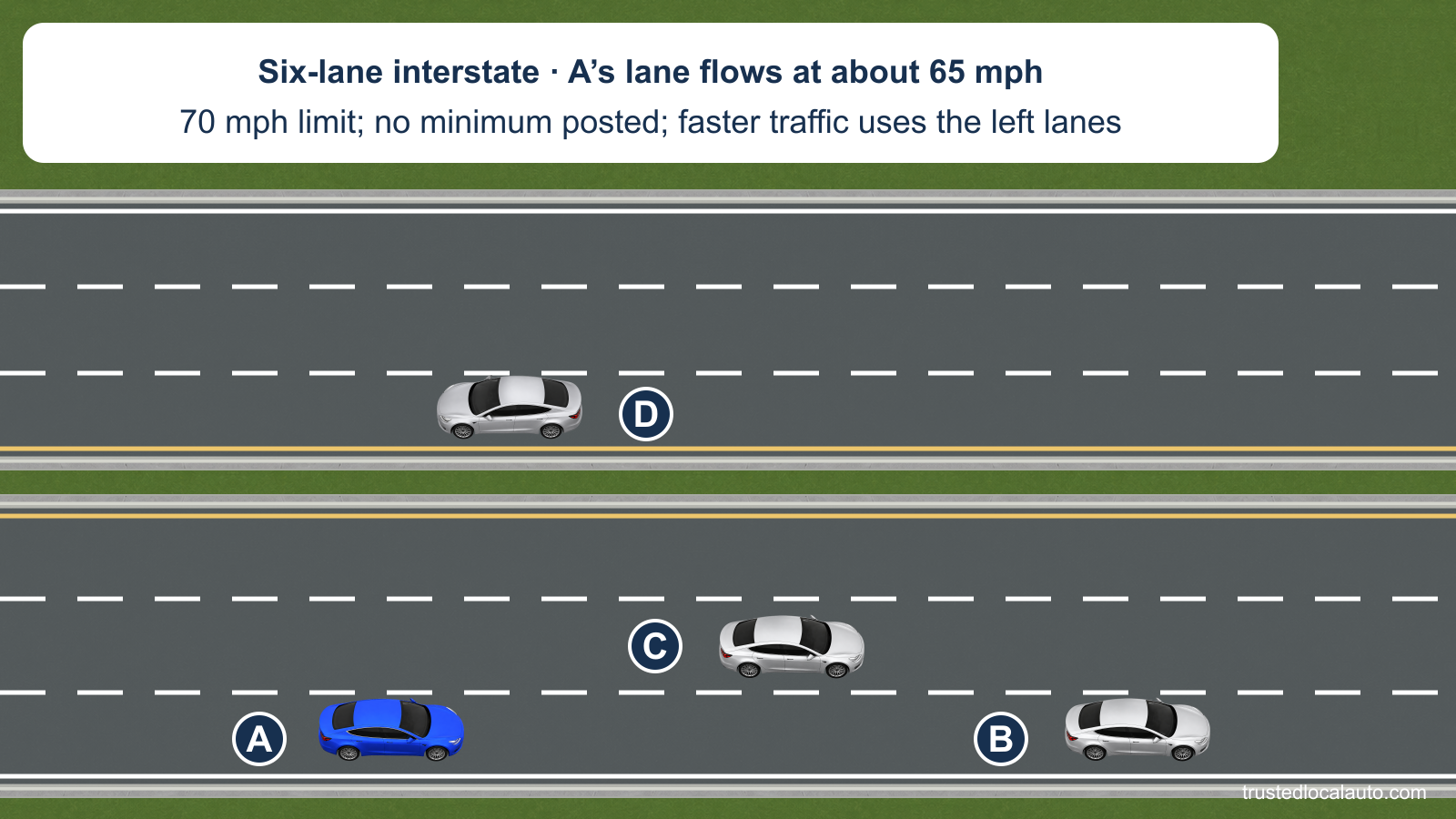
Correct answer: About 65 mph, with the traffic in your lane and within the limit
Why
Traffic on an interstate moves much faster than on an ordinary road, so drivers behind a slow car close the gap very quickly. Keep right unless you pass, and match the speed of your lane so that other drivers can predict what you will do. To keep a space cushion at interstate speed, use the two-second rule and look farther ahead as your speed increases.
Verified against North Carolina Driver Handbook · Interstate Highways · p. 66, 67
Is this question correct and clear?
Continue learning
Related North Carolina questions
- You enter an interstate acceleration lane at 30 mph. Traffic in the right lane of the interstate moves at about 65 mph, and the speed limit is 70 mph. How should you use the acceleration lane?
- You drive at 65 mph in the right lane of an interstate. Your exit is 1 mile ahead, and a sign shows an exit ramp speed of 35 mph. How should you leave the interstate?
- Your car breaks down on an interstate in daylight. You steer it well off the road onto the shoulder. Which action does the North Carolina handbook tell you to take?
- You are near the end of an interstate acceleration lane. A pickup truck in the right lane of the interstate is beside you, and its driver does not slow down or move over. Under North Carolina law, who must yield?
- You plan a six-hour drive, mostly on interstates. Which plan follows the North Carolina handbook's advice to prevent drowsy driving?
- On interstate and primary highways, North Carolina posts minimum speeds. Which pair of minimum speeds does the handbook give for a 55 mph zone and for a zone of 60 mph or more?