
Practice question, Question 1 of 30
Passing target: 80% (24/30)
On an interstate, you drive next to the cab of a tractor-trailer, in the lane to its left. You look at the truck's side mirror, but you cannot see the truck driver's face in it. What does this tell you?
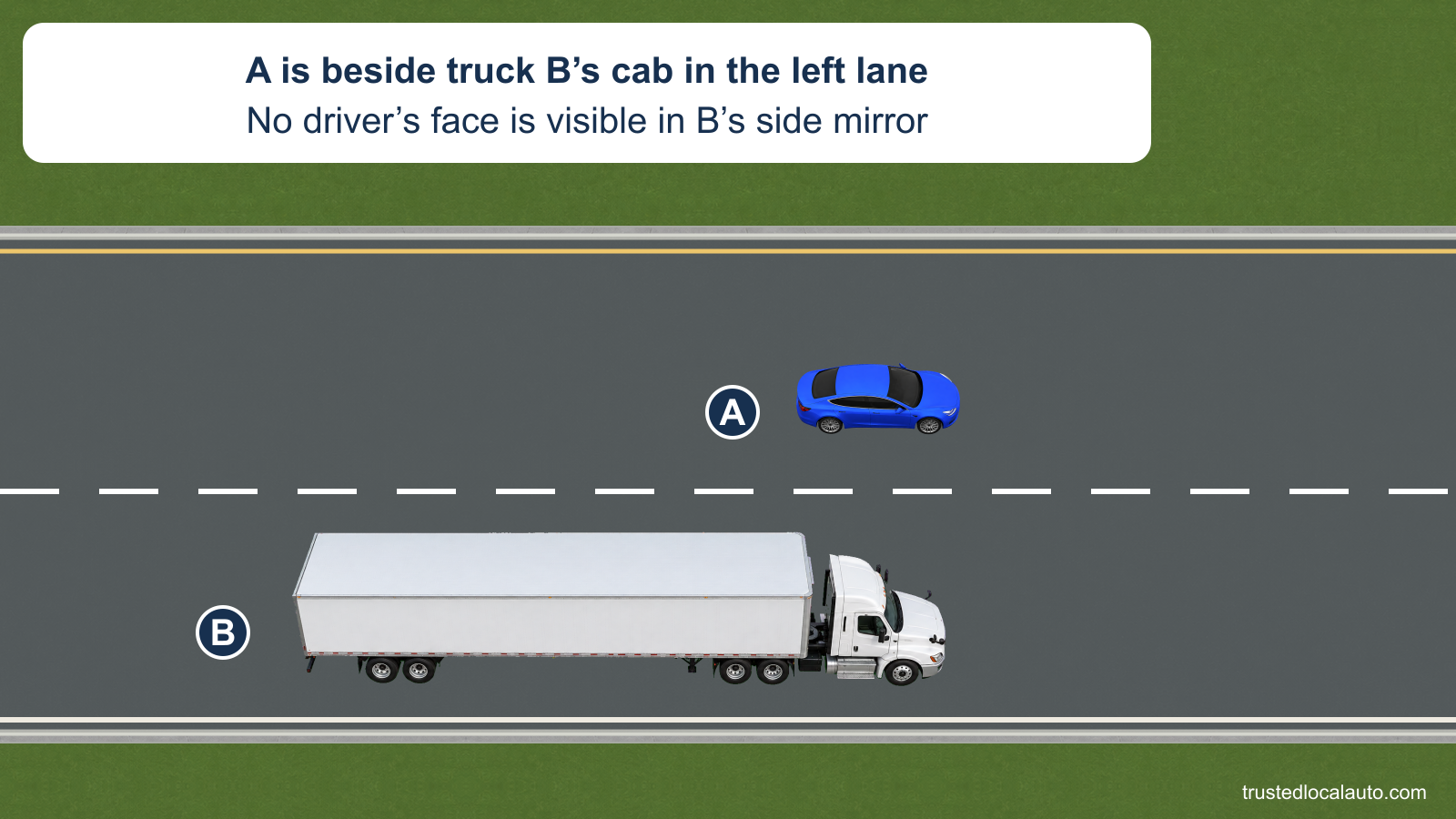
Correct answer: The truck driver likely cannot see your car, because you are in a blind spot.
Why
A tractor-trailer has large blind spots, called No-Zones: up to 20 feet in front of the cab, along both sides, and up to 200 feet behind the trailer. A car in a No-Zone can disappear from the truck driver's view, and a lane change by the truck can then hit it. When you pass a truck, do it steadily, and do not stay beside it longer than you must.
Verified against North Carolina Driver Handbook · No-Zones · p. 93, 94
Is this question correct and clear?
Continue learning
Related North Carolina questions
- A friend plans to ride a bicycle on a two-lane road that has no bicycle lane. Which advice about the direction of travel agrees with North Carolina law and the handbook?
- On a two-lane rural road, you come up fast behind a slow tractor that pulls a wide implement. As you get close, the tractor slows down and its driver signals a left turn. What should you do?
- You drive in the right lane of a highway with two lanes in your direction. Ahead, a fire truck is stopped on the right shoulder with its warning lights flashing. The left lane beside you is clear. What must you do?
- You are waiting at a green light. A funeral procession, with headlights and hazard lights on, is going through the intersection against its red light, behind a lead car that entered on green. What should you do?
- On a two-lane road, a solid yellow line is on your side of the center line. A moped rides at the right edge of your lane. The rider is not about to turn left, the opposing lane is clear for a long distance, and the other passing rules are met. Which statement is correct?
- On a four-lane highway, a motorcycle rides near the left side of your lane, and there is room to its right. You want to pass it. What should you do?