
Practice question, Question 1 of 40
Passing target: 75% (30/40)
On a two-lane, two-way road, the center has a solid yellow line beside a broken yellow line. Driver A goes north in the lane next to the broken line. Driver B goes south in the lane next to the solid line. The road ahead is clear. Who may cross the center to pass a slower car?
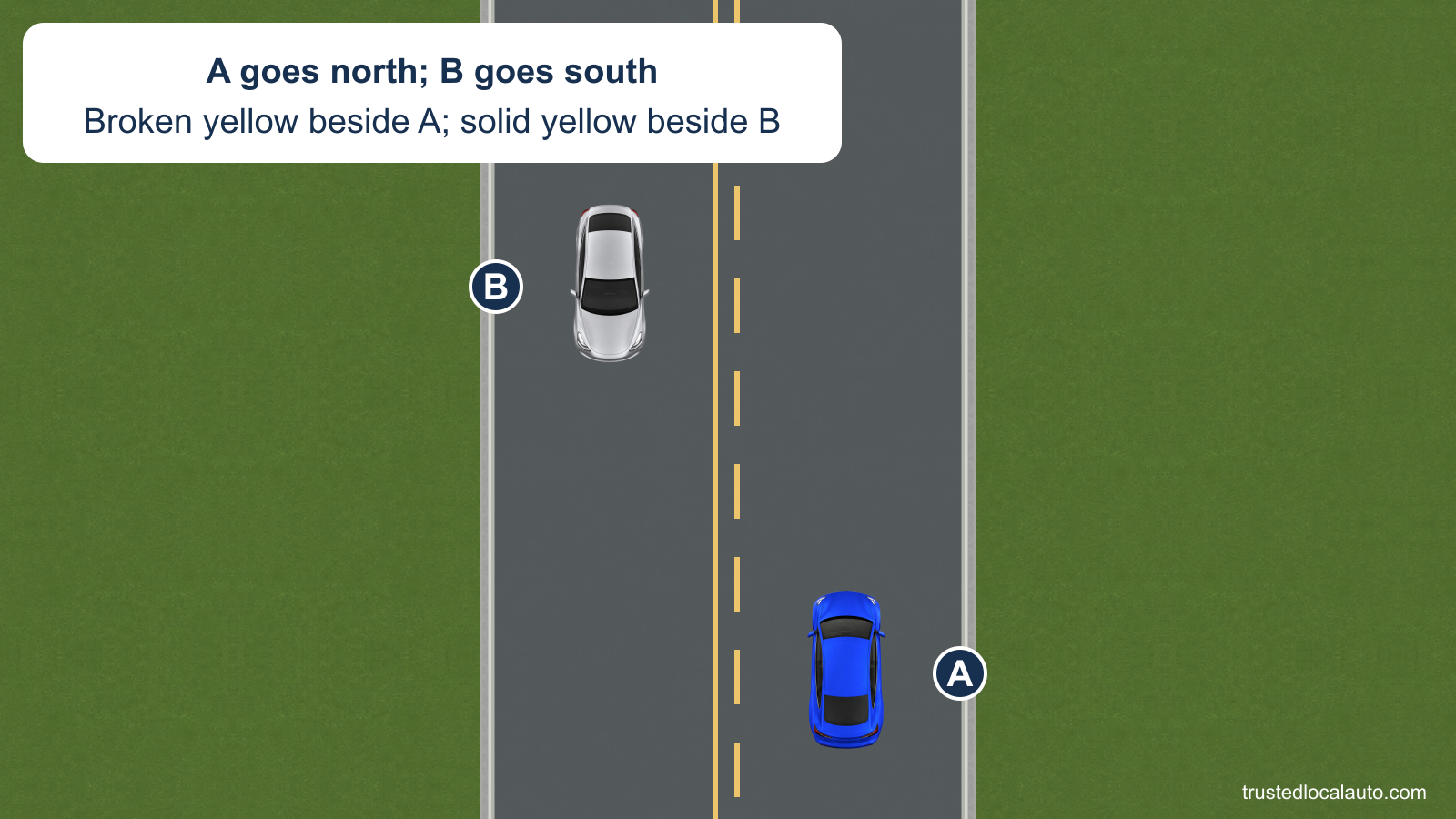
Correct answer: Only Driver A, because the broken line is on the side of Driver A's lane.
Why
When a solid and a broken yellow line run side by side, each driver reads the line nearest to his or her own lane. A broken line on your side means that you may pass when the road ahead is clear for the whole pass; a solid line on your side means that you may not. Even where passing is allowed, Ohio law requires you to return to your lane before you come within 200 feet of an oncoming vehicle (ORC 4511.29).
Verified against Ohio Driver Manual · Lane pavement markings · p. 16, 24
Is this question correct and clear?
Continue learning
Related Ohio questions
- You drive in the right-hand lane of a four-lane road. A broken white line separates your lane from the lane on your left. You plan to turn left at the next intersection. What does the broken white line tell you?
- You drive on a two-lane, two-way road with a 55 mph limit. Double solid yellow lines mark the center. A car ahead of you goes 45 mph, and you see no oncoming traffic. What should you do?
- On a two-lane, two-way road with a 55 mph limit, double solid yellow lines mark the center. A car ahead goes 45 mph, and you see no oncoming traffic. What should you do?
- You approach an intersection where this red light flashes on and off. What must you do?
- You approach an intersection where this yellow light flashes on and off. What should you do?
- You are in a lane where you may turn left or go straight. The signal shows a green arrow that points left, and the circular light beside it is red. What may you do?