
Practice question, Question 1 of 18
Passing target: 83.3% (15/18)
Driver A goes north, and Driver B goes east. They reach an intersection with no signs or signals at about the same time, and both plan to go straight. Who must yield?
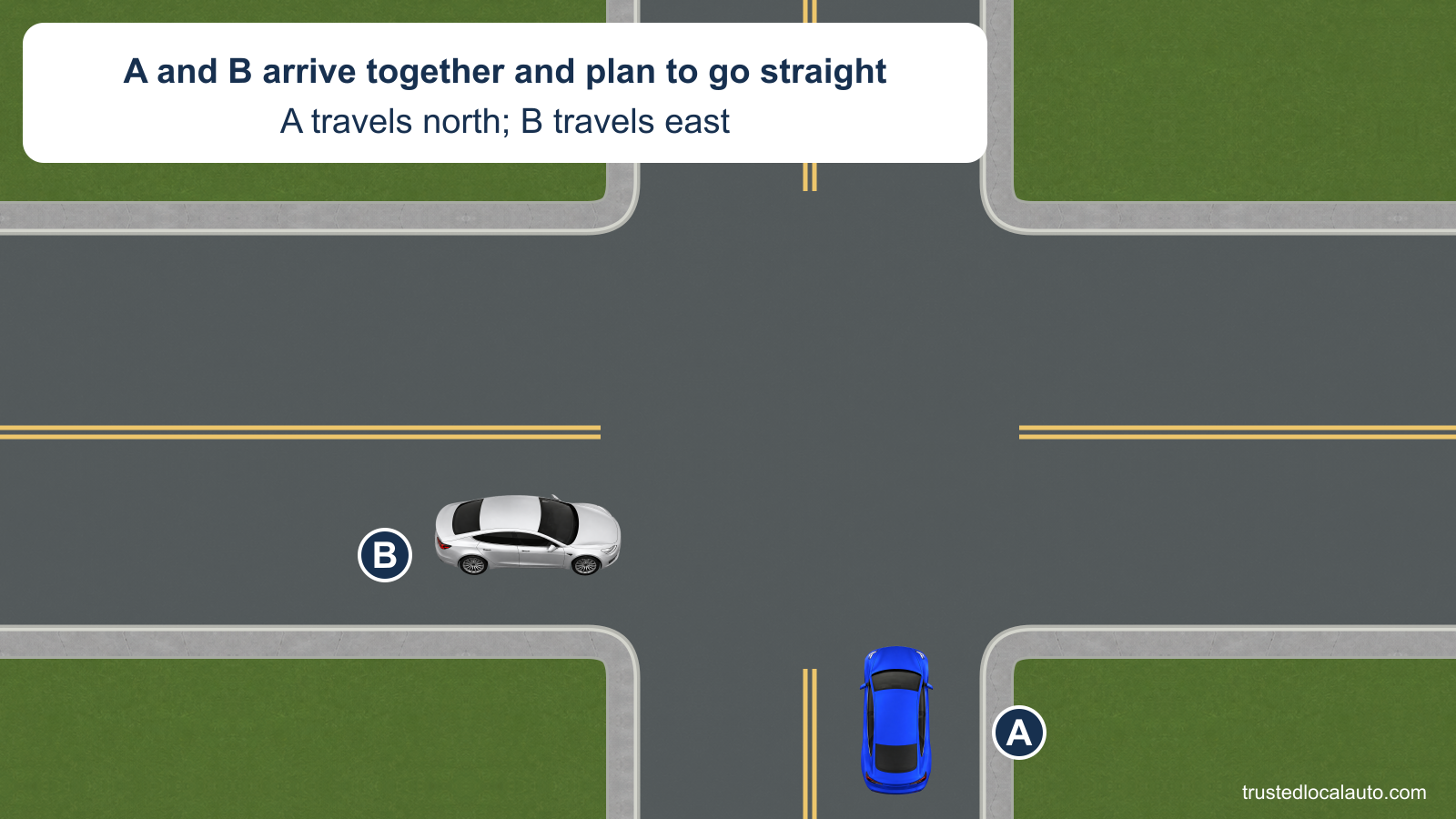
Correct answer: Driver B, because Driver A is on Driver B's right.
Why
The rule applies when no signs, signals or police control the intersection, and also to drivers who reach a four-way stop at the same time. It does not apply on a through highway, on a limited-access highway or in a traffic circle, where the traffic on that road goes first. Even when the other driver must yield, be ready to stop if that driver does not.
Verified against Pennsylvania Driver's Manual · Negotiating Intersections · p. 52, 14, 42
Is this question correct and clear?
Continue learning
Related Pennsylvania questions
- You are in the middle of an intersection on a green light when a fire truck comes up behind you with its siren on and its red lights flashing. What should you do?
- You drive in a single-lane roundabout. A car waits at the next entry, which is on your right, and you will drive past that entry. Who goes first?
- You stop at the yield line of a single-lane roundabout. Which vehicles must you yield to before you enter?
- You drive out of a store parking lot onto a two-lane road. A car on the road comes from your left. If you pull out now, that car will have to slow down for you. Who goes first?
- You signal and slow down to turn left into a driveway in the middle of a block. An oncoming car is close enough to be a hazard. There is no intersection here. What must you do?
- You drive toward an intersection that has no traffic signal and no painted crosswalk lines. A pedestrian steps off the corner to walk across your street. What must you do?