
Practice question, Question 1 of 18
Passing target: 83.3% (15/18)
You drive into a sharp curve that bends to the right, and you are going too fast for it. If your tires cannot hold the road, where will your vehicle tend to go?
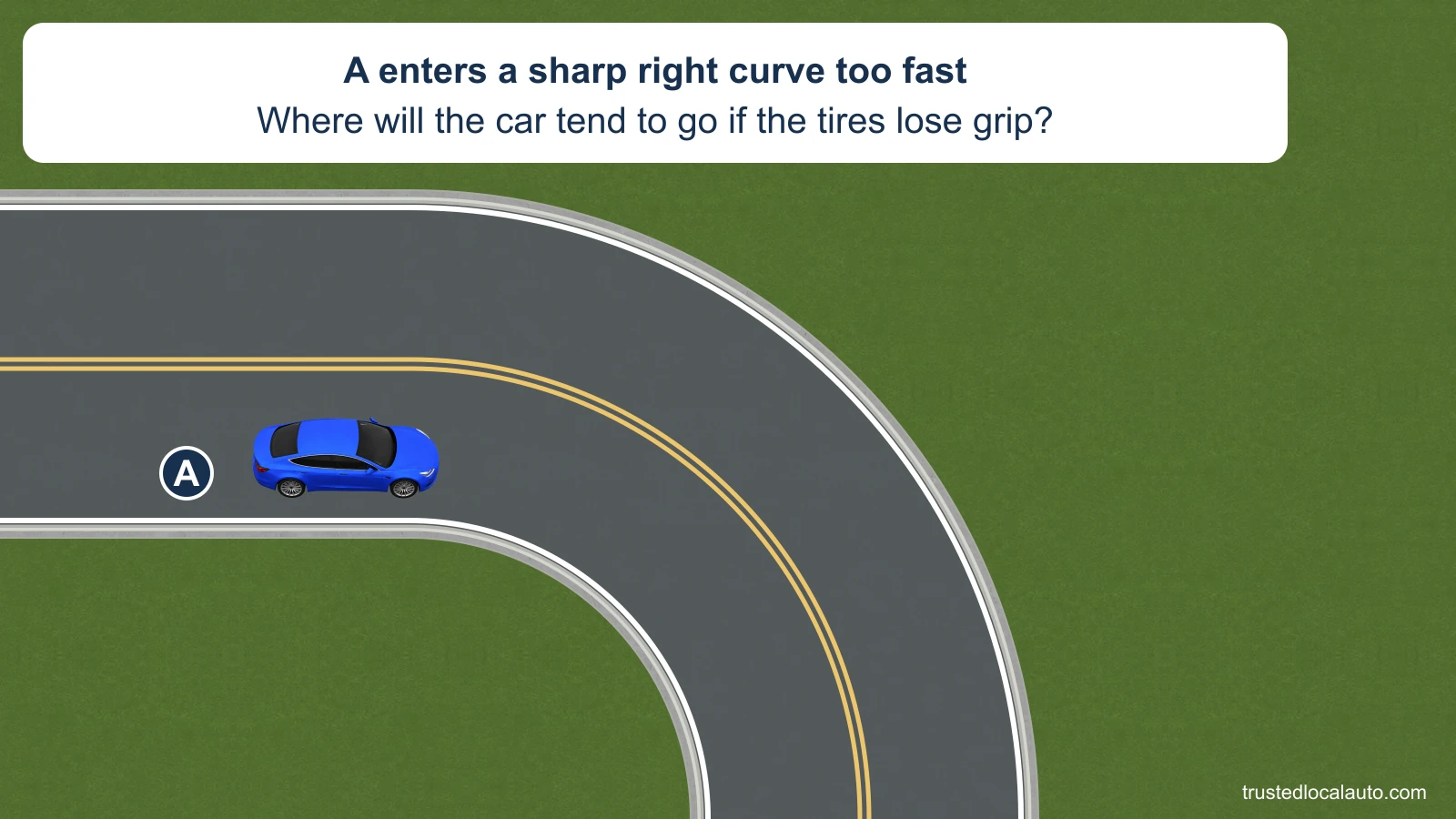
Correct answer: Straight ahead, across the center line into the oncoming lane.
Why
You cannot beat the laws of physics in a curve, so slow down before you enter it, not in it. The sharper the curve, the more you must slow, and a sharp curve on a wet or icy road needs the largest speed reduction. On a right curve, keep slightly to the right of the lane center, and look ahead at the inside edge of the curve to guide your steering.
Verified against Pennsylvania Driver's Manual · Negotiating Curves · p. 55
Is this question correct and clear?
Continue learning
Related Pennsylvania questions
- On a long, steep upgrade of an interstate, a loaded truck in your lane ahead of you turns on its hazard flashers. What should you understand, and what should you do?
- At night, you drive on a dark, unlit road with a posted limit of 55 mph. Cars come toward you, so you use your low beams, which light about 250 feet ahead. What is the highest speed that the manual advises so that you can stop within the distance that you can see?
- On a two-lane road with one lane in each direction, a driver follows very close behind you. What is the safest way to deal with this?
- You are stopped at a STOP sign. You looked left and then right, and both directions seemed clear. Why should you look to the left once more before you pull out?
- On a dry road, you count about 3 seconds from the moment the car ahead passes a sign until your car reaches it. Which minimum following time applies on this road?
- On a dry road, the car ahead of you passes a road sign, and you start to count. Your car passes the same sign after about 3 seconds. What should you do?