
South Dakota Operator License Knowledge Practice Test
Full test preview Question 1 of 30
0 answered 30 remaining
Passing target: 80% (24/30)
At 50 mph on dry pavement with good brakes, a car needs about 158 feet of braking distance. What is true of the total distance that the car travels from the moment a hazard appears until it stops?
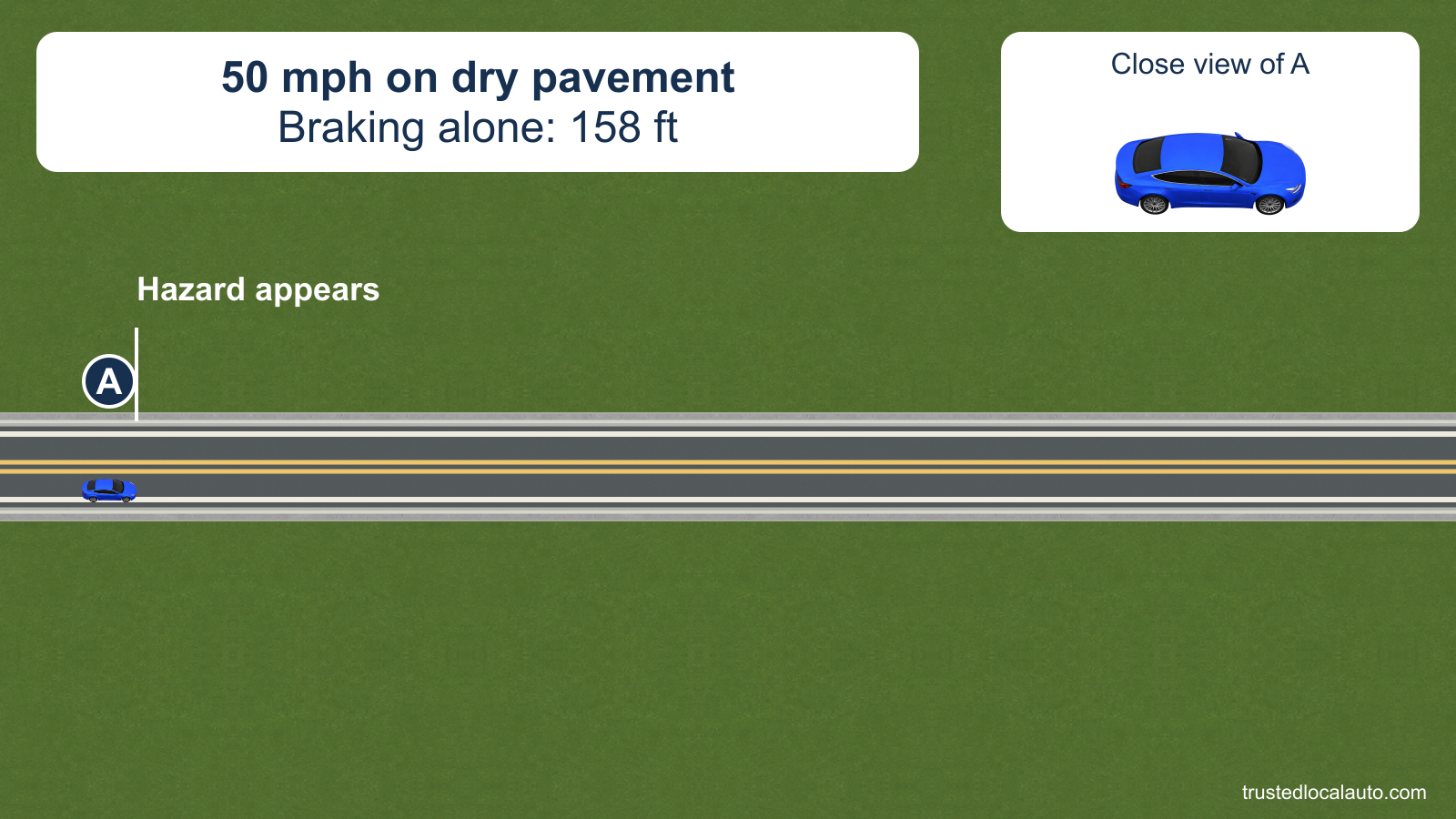
Blue car A is at the starting point labelled Hazard appears on a dry road. The card gives the stem’s 50 mph speed and 158-foot braking distance. No stopping point, braking-start point, stage bands or total distance appears.
Correct answer: It is longer than 158 feet, because the car keeps moving while the driver sees the hazard and reacts.
Why
Stopping distance has three parts: perception (you recognize the hazard), reaction (you move your foot to the brake) and braking. At 50 mph a car moves about 73 feet each second, so 1 1/2 to 2 seconds of perception and reaction adds roughly 110 to 150 feet before the brakes work. Higher speed, a tired or distracted driver and a slippery road all make the total longer.
Verified against South Dakota Driver License Manual · Braking and stopping · p. 50
Report a question issueContinue learning