
Practice question, Question 1 of 40
Passing target: 70% (28/40)
You drive in the right lane of a highway. You pass a yellow diamond that shows the arrow of your road and a second arrow that joins from the right and then runs next to it. What does this tell you?
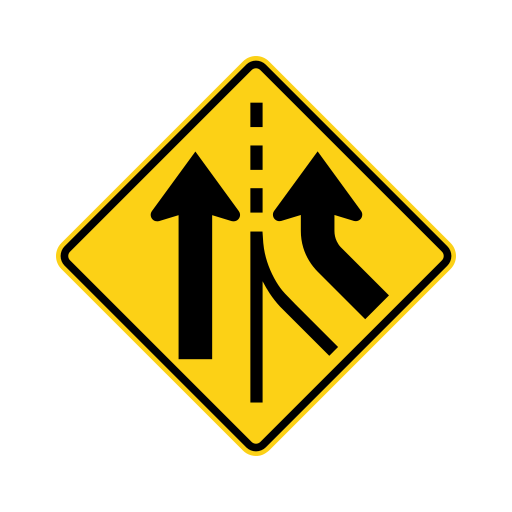
Correct answer: A new lane starts beside you, so you need not merge; watch that lane
Why
Drivers often confuse this sign with the merge sign. On a merge sign, the joining lane flows into your lane, and you must watch for vehicles that move over. On an added-lane sign, the joining traffic gets its own lane, so it is not a forced merge. Drivers in the new lane can still change lanes later, so check your mirrors and keep space around you.
Verified against Texas Driver Handbook · Warning Signs (Table 18) · p. 33, 34
Is this question correct and clear?
Continue learning
Related Texas questions
- The speed limit on a rural highway is 60 mph. You see this yellow curve warning sign with a yellow plate below it that reads 35 MPH. What does the 35 MPH plate tell you?
- You see this sign on a two-lane rural road. What should you expect ahead?
- You drive on a two-lane, two-way road and pass a yellow diamond sign. It shows two black lines that split around a black island shape ahead. What should you expect after this point?
- You drive on the right-hand roadway of a divided highway, with a wide median on your left. You pass a yellow diamond that shows two black lines on each side of an island shape, and the lines come together beyond the island. What should you prepare for?
- You drive at 55 mph on a rural road. Ahead, a tractor pulls a hay wagon with this emblem on the back. The emblem marks vehicles that are designed to go no faster than a set speed. What is that speed?
- On a freeway, you drive in the right lane. Above your lane is this green sign with a down arrow and a yellow panel that reads EXIT ONLY. You want to stay on the freeway. What should you do?