
Practice question, Question 1 of 40
Passing target: 70% (28/40)
You are in the right lane of a freeway at 70 mph, and your exit is just ahead. The ramp leads to a road with a 45 mph limit. Where should you do most of your slowing down?
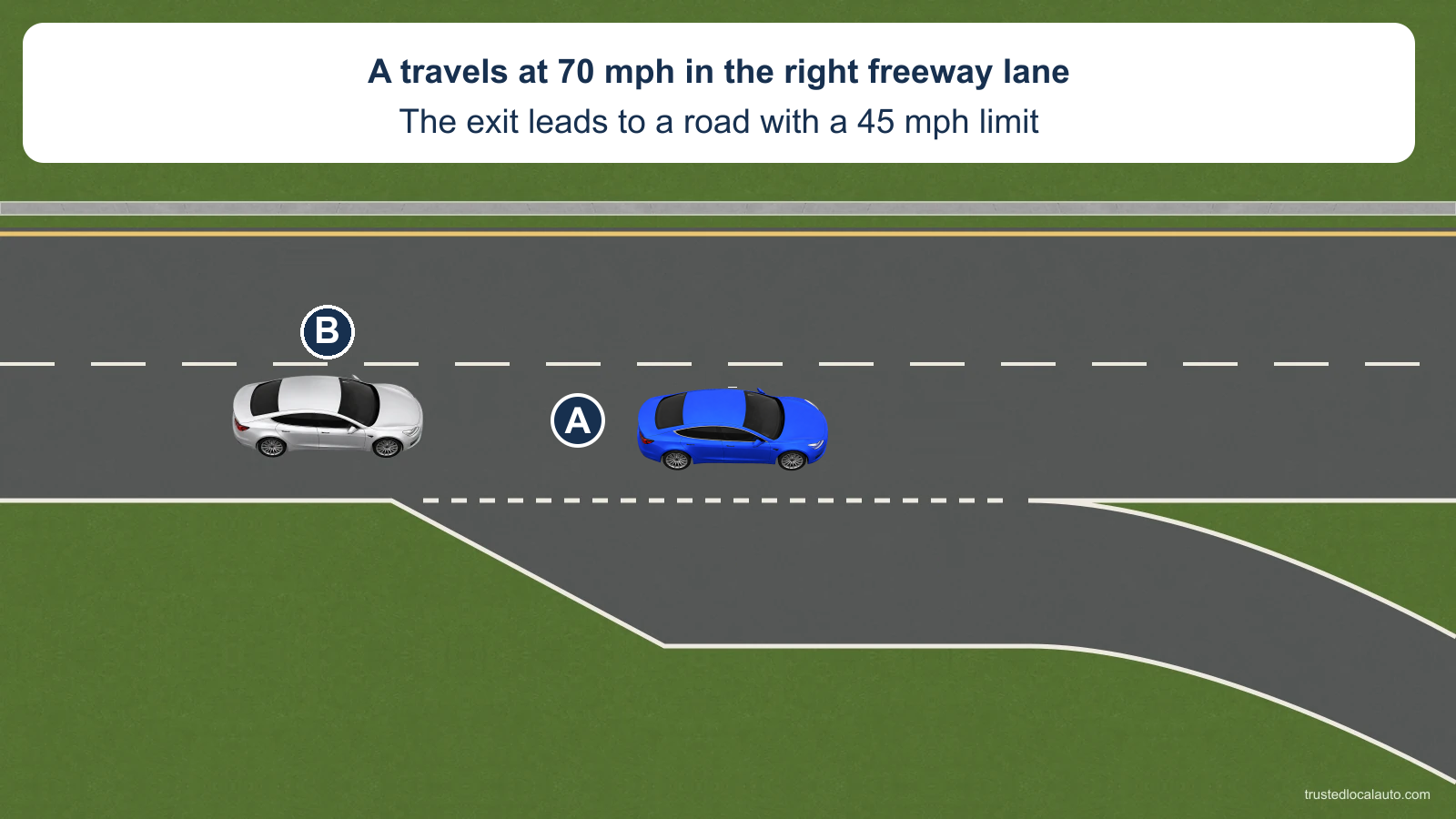
Correct answer: On the exit ramp, so that you reach the new road at its lower limit
Why
Traffic behind you still moves at freeway speed, so braking hard in a through lane invites a rear-end crash. Move into the exit lane early, keep up with traffic until you are on the ramp, and then slow down along the ramp. Exit signs are usually at least 1,000 yards before the exit, which gives you time to get into the correct lane.
Verified against Texas Driver Handbook · Leaving the Highway · p. 54
Is this question correct and clear?
Continue learning
Related Texas questions
- You drive on a one-way frontage road beside a freeway. Ahead, a car comes down the exit ramp from the freeway and will enter the frontage road. Which statement is correct?
- You drive on a one-way frontage road beside a freeway. Ahead, a car comes down the exit ramp from the freeway and will enter the frontage road. Who must yield?
- You enter a freeway on a ramp that leads into an acceleration lane. Traffic in the right lane of the freeway moves at about 65 mph. You are at 45 mph, and you see a safe gap coming up in the right lane. What should you do?
- You stop at a STOP sign that has an ALL WAY plate below it. A moment later, a car stops at the STOP sign on the street to your right. That street has four lanes, and yours has two. Both of you plan to go straight. Which statement is correct?
- You stop at a STOP sign that has an ALL WAY plate below it. At the same moment, a car stops at the STOP sign on the street to your right. Both of you plan to go straight. Which driver should go first?
- Your street ends at a T-intersection with a through street. There is no sign or signal. You want to turn right, and a car on the through street comes from your left. What must you do?