
Practice question, Question 1 of 40
Passing target: 70% (28/40)
Driver A and Driver B reach an intersection of two equal paved streets at about the same time. No sign or signal controls it. Driver B comes from Driver A's right. Who must yield?
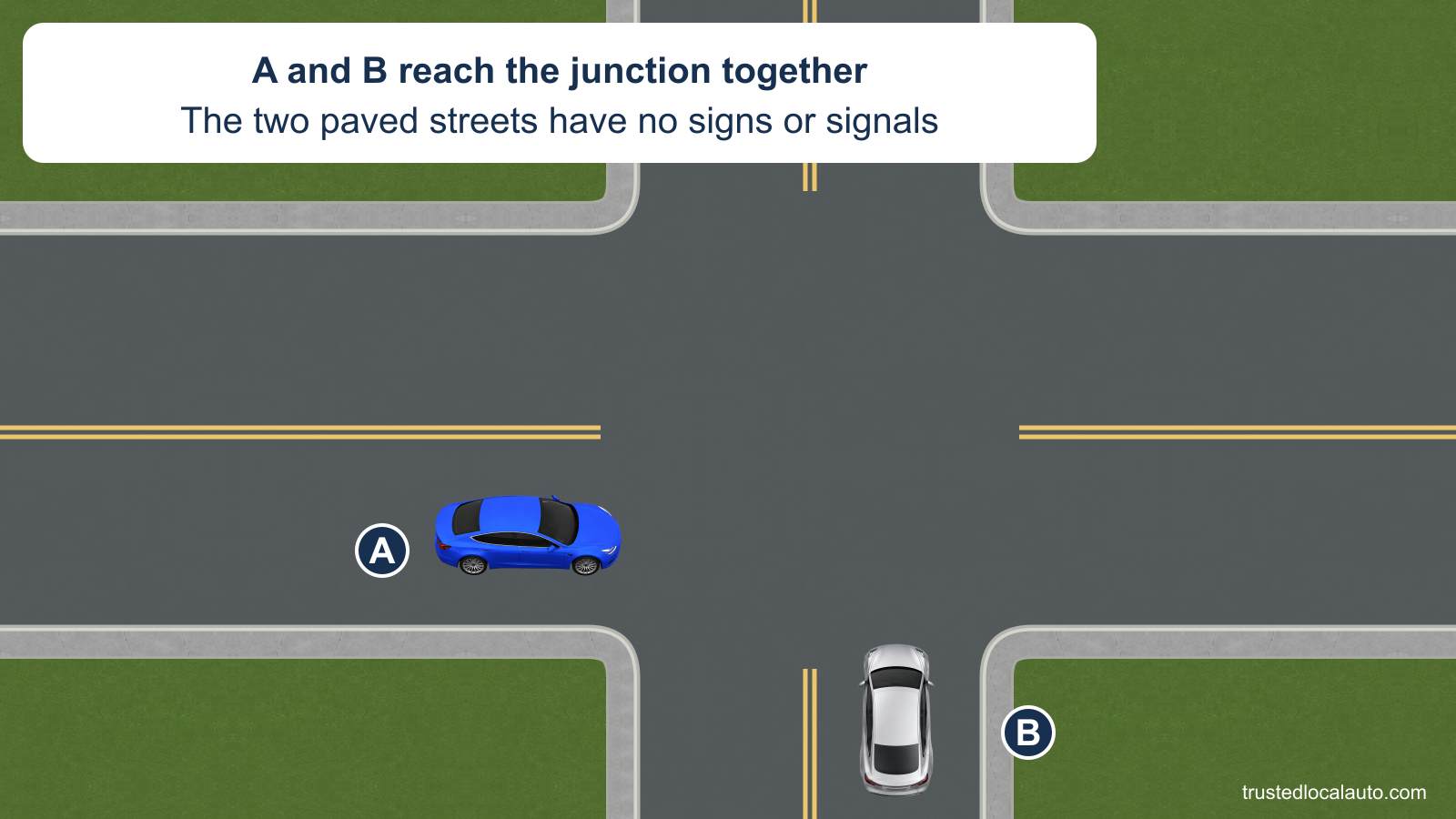
Correct answer: Driver A, because a driver must yield to a vehicle that comes from the right
Why
The right-hand rule gives drivers a way to agree who goes first when nothing else controls the intersection. It applies only when neither road is larger, and neither road is paved while the other is not; those cases have their own rules. Even when the rule gives you the right-of-way, look to the left too and go only when the other driver clearly yields.
Verified against Texas Driver Handbook · Right-of-Way · p. 26
Is this question correct and clear?
Continue learning
Related Texas questions
- You stop at a STOP sign that has an ALL WAY plate below it. A moment later, a car stops at the STOP sign on the street to your right. That street has four lanes, and yours has two. Both of you plan to go straight. Which statement is correct?
- You stop at a STOP sign that has an ALL WAY plate below it. At the same moment, a car stops at the STOP sign on the street to your right. Both of you plan to go straight. Which driver should go first?
- Your street ends at a T-intersection with a through street. There is no sign or signal. You want to turn right, and a car on the through street comes from your left. What must you do?
- You come to a single-lane roundabout. A car is already moving around the circle and will pass in front of your entry. What should you do?
- You drive out of a driveway in a residential area. A teen on a scooter rides along the sidewalk toward your driveway, and cars come along the street. What must you do?
- You drive on a two-lane street and want to turn left into a store driveway in the middle of the block. An oncoming car is close. What should you do?