
Practice question, Question 1 of 40
Passing target: 70% (28/40)
You drive on a gravel road and stop where it meets a paved road. No sign controls the intersection. You stopped first, and now a car on the paved road comes near the intersection. What should you do?
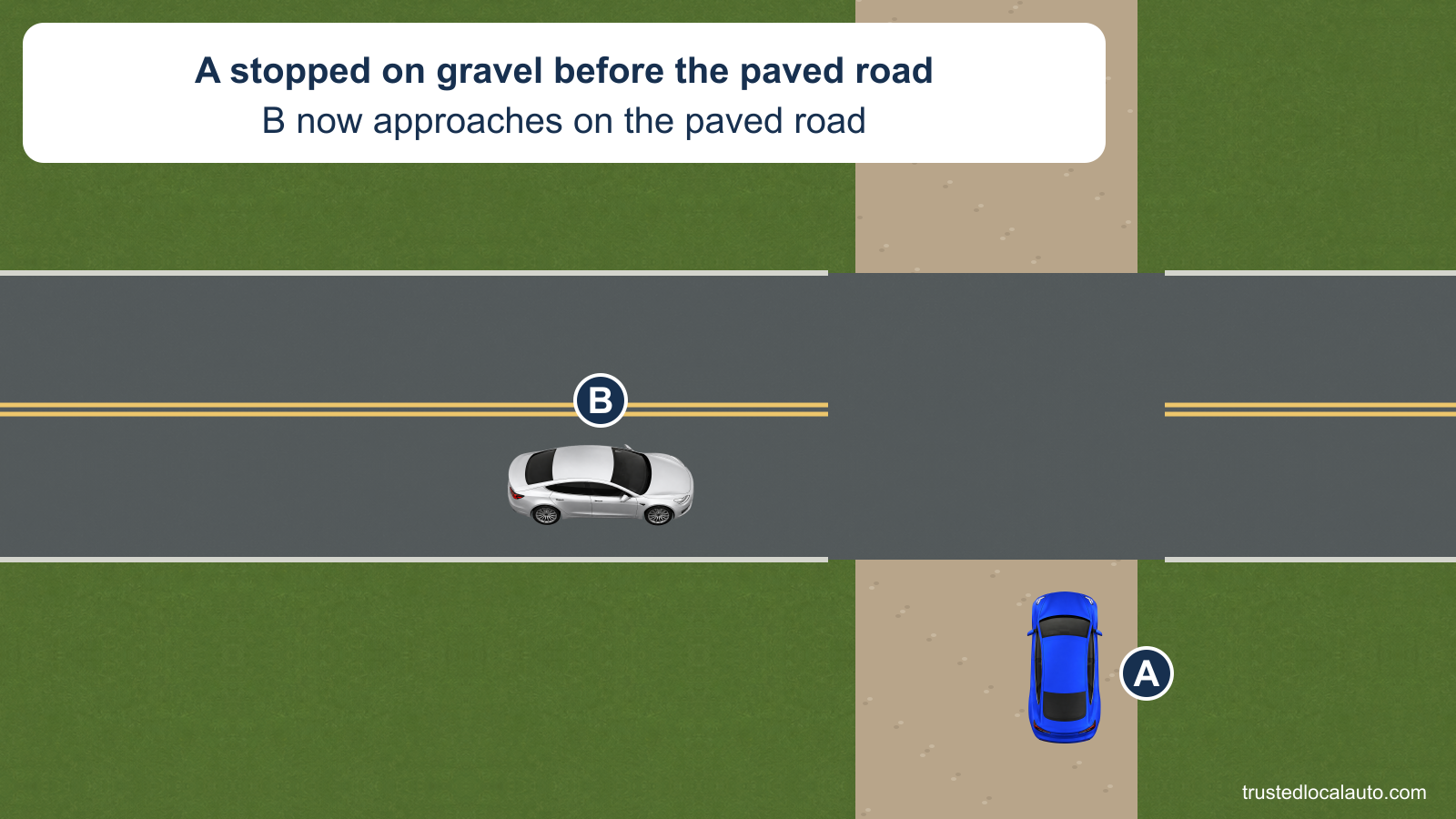
Correct answer: Yield to the car on the paved road, then go when it is safe.
Why
Vehicles on paved roads usually move faster, and a car that starts on loose gravel can spin its wheels and enter the road slowly. Texas law tells the driver on the unpaved road to stop and yield to paved-road traffic that is in the intersection or close enough to be a hazard. Wait for a gap that is large enough to accelerate gently onto the pavement.
Verified against Texas Driver Handbook · Right-of-Way · p. 26
Is this question correct and clear?
Continue learning
Related Texas questions
- You stop at a STOP sign that has an ALL WAY plate below it. A moment later, a car stops at the STOP sign on the street to your right. That street has four lanes, and yours has two. Both of you plan to go straight. Which statement is correct?
- You stop at a STOP sign that has an ALL WAY plate below it. At the same moment, a car stops at the STOP sign on the street to your right. Both of you plan to go straight. Which driver should go first?
- Your street ends at a T-intersection with a through street. There is no sign or signal. You want to turn right, and a car on the through street comes from your left. What must you do?
- You come to a single-lane roundabout. A car is already moving around the circle and will pass in front of your entry. What should you do?
- You drive out of a driveway in a residential area. A teen on a scooter rides along the sidewalk toward your driveway, and cars come along the street. What must you do?
- You drive on a two-lane street and want to turn left into a store driveway in the middle of the block. An oncoming car is close. What should you do?