
Practice question, Question 1 of 50
Passing target: 80% (40/50)
Heavy rain falls on the freeway, and the pavement is wet. Traffic moves at the posted speed. How should you set your following distance?
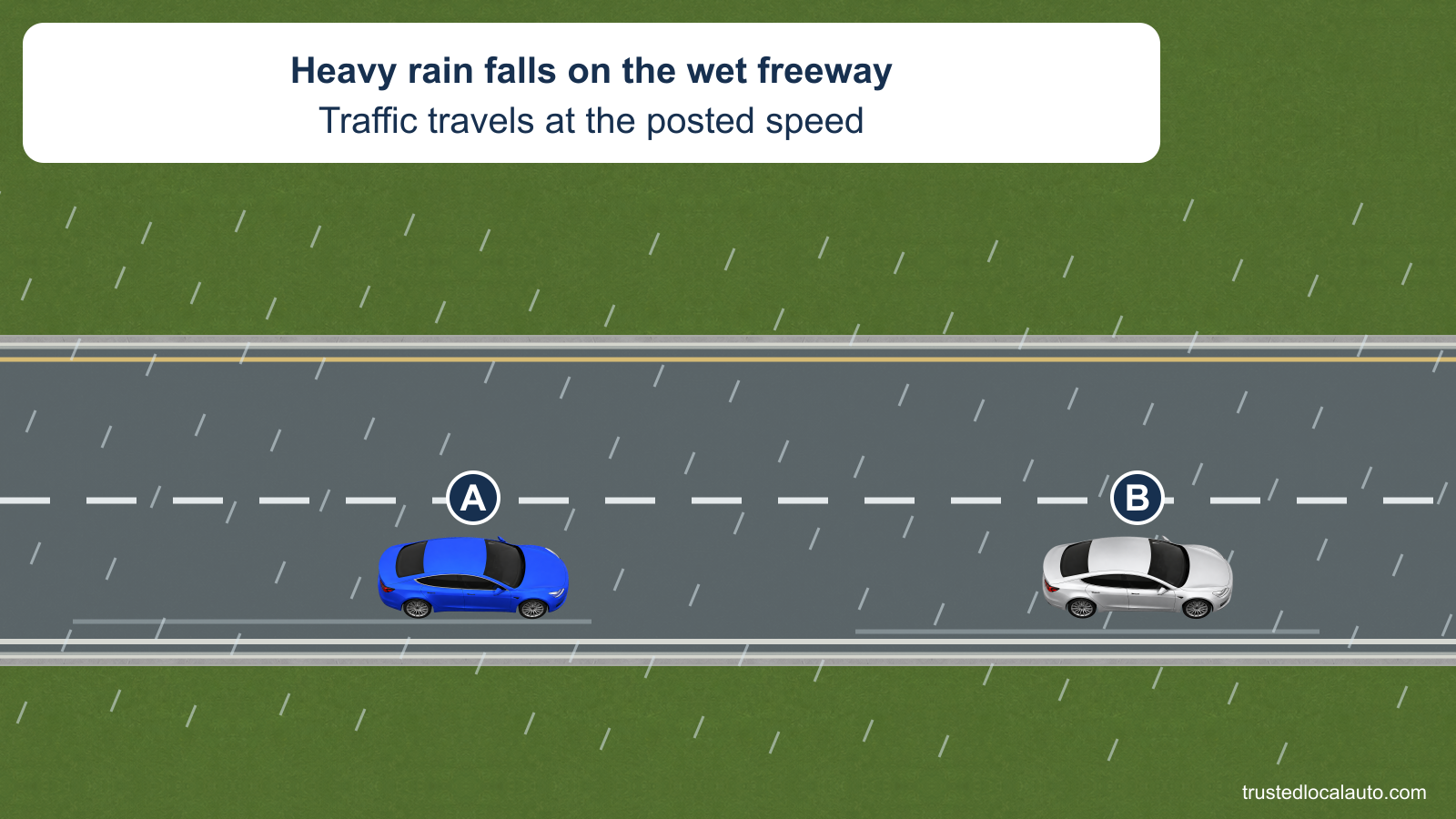
Correct answer: Increase it to well over the two-second minimum
Why
Two seconds is the minimum following time for good conditions. On wet, icy or snowy roads, or when rain and spray reduce what you can see, add more time. Utah law says a driver may not follow more closely than is reasonable for the speed, the traffic and the condition of the highway. A larger gap also gives you a better view of hazards around the vehicle ahead.
Verified against Utah Driver Handbook · Freeway driving: following distance in bad conditions · p. 36, 49
Is this question correct and clear?
Continue learning
Related Utah questions
- You drive on a narrow two-lane road. Ahead is a sharp curve, and trees hide the road beyond it. When should you reduce your speed?
- You are moving to a new home. Boxes stacked on the front passenger seat block your view through the right side window and of the right outside mirror. What should you do before you drive?
- You plan to move from the right lane to the left lane. Your mirrors show that the left lane is clear, and your signal is on. What should you do before you steer into the left lane?
- You leave the pavement and drive on a gravel county road. How should you change your driving?
- Rush-hour traffic on a city street is congested and moves at about 20 mph. Which statement about the two-second minimum in Utah law is correct?
- You are first in line at a red light. Your light turns green. A car on the cross street is still coming toward the intersection fast and does not seem to slow down for its red light. What should you do?