
Practice question, Question 1 of 50
Passing target: 80% (40/50)
You drive on a dark two-lane highway with your high beams on. One car is ahead of you in your lane, and another car comes toward you. When must you switch to low beams?
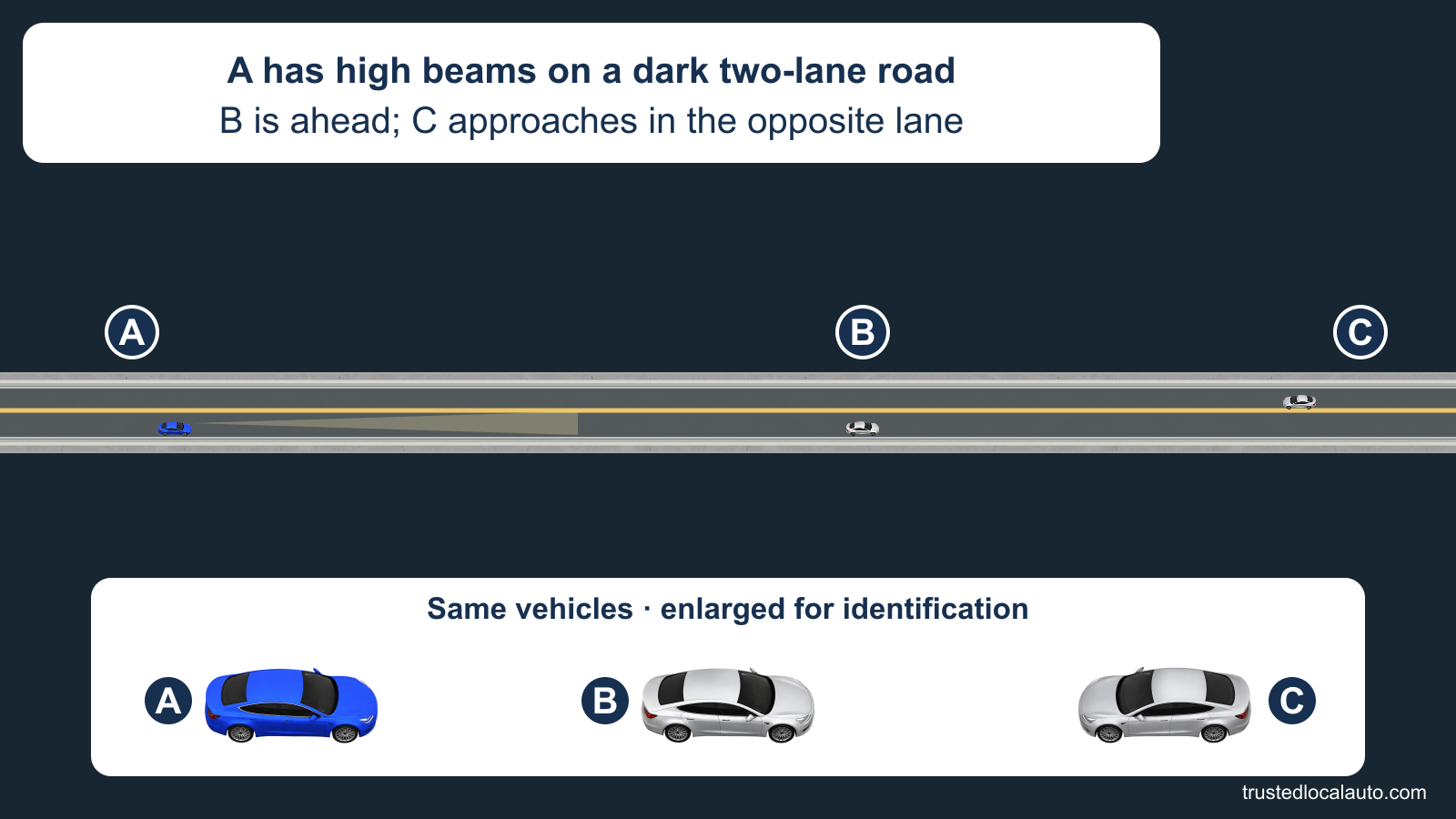
Correct answer: Within 500 feet of the oncoming car, and within 300 feet of the car you follow
Why
High beams can blind another driver for a few seconds, and a blinded driver can drift into your lane. If an oncoming driver does not dim, do not look into the lights; look toward the right edge of your lane until the car passes. Go back to high beams when it is safe, because they let you see farther on dark roads.
Verified against Utah Driver Handbook · J. Night Driving: dimming high beams · p. 70
Is this question correct and clear?
Continue learning
Related Utah questions
- While you drive, you press the brake pedal and the brakes do not work. You apply the parking brake slowly, but it does not work either. What does the handbook tell you to do next?
- On a hot summer day, your car breaks down on a desert highway. You see no call box and no buildings nearby. What should you do?
- After a night of snow, you have a short drive to work. Snow covers the whole car. What must you clear before you drive?
- At dusk, you drive on a two-lane highway. A deer stands on the shoulder ahead, and a car comes toward you in the other lane. What is the best action?
- A lightning storm starts while you drive a car with a hard metal roof, and there is no building nearby. What is the safest thing to do?
- Thick fog forms on a rural highway in the morning. You can see only about 200 feet ahead, and the speed limit is 65 mph. What should you do?