
Practice question, Question 1 of 50
Passing target: 80% (40/50)
At an intersection with stop signs on all four approaches, you and a car on the cross street to your right come to a complete stop at the same time. You want to go straight, and the other driver signals a left turn. Who should go first?
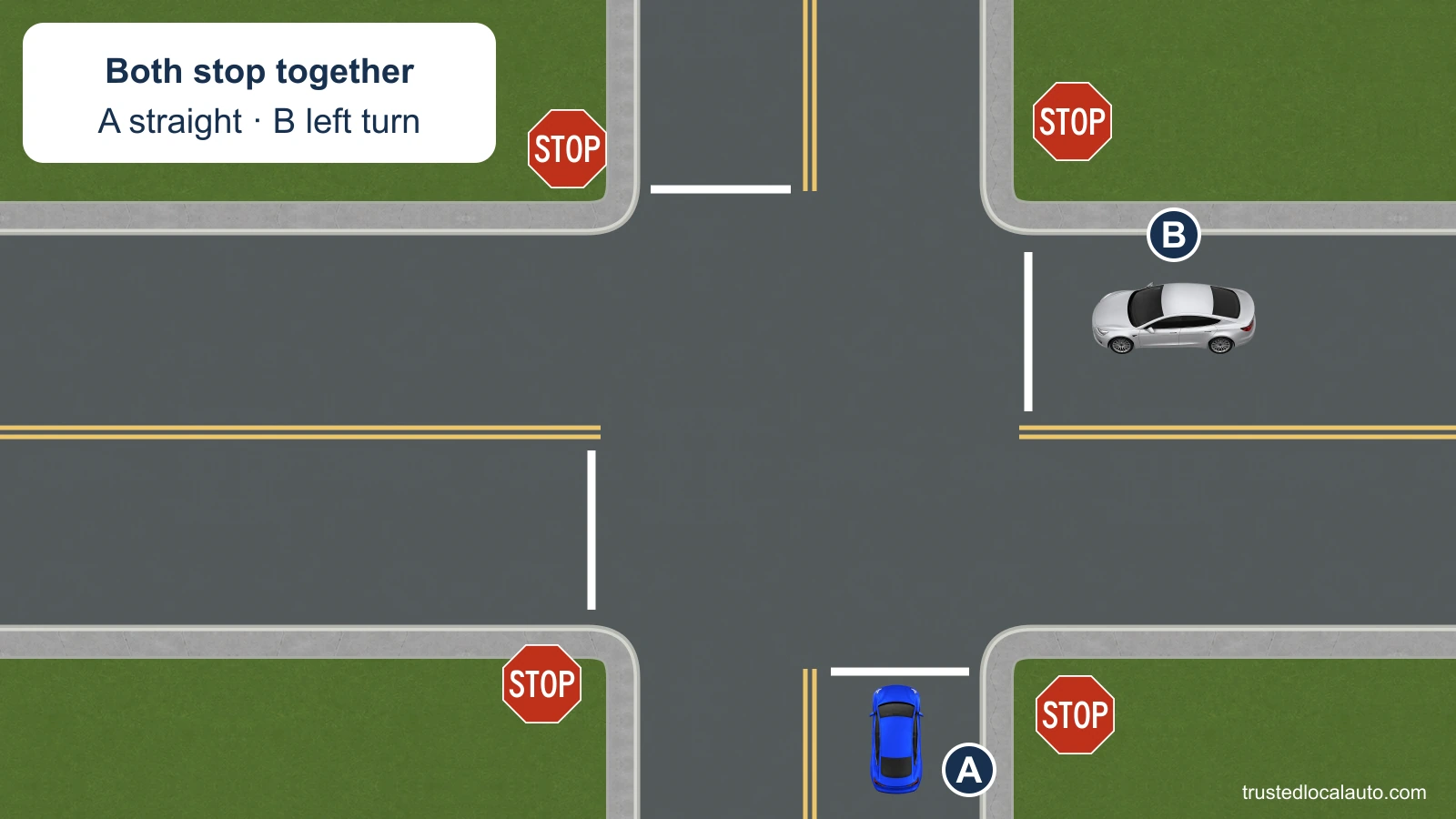
Correct answer: The car on your right goes first, because you are the driver on the left
Why
At an all-way stop, the first vehicle to stop is the first to go. When two vehicles stop at about the same time, the driver on the left yields to the driver on the right. Utah law uses the same rule at an intersection with no signs or signals and at a signal that does not work. Even when it is your turn, make sure that the other driver is waiting before you go.
Verified against Utah Driver Handbook · Yielding right-of-way · p. 60
Is this question correct and clear?
Continue learning
Related Utah questions
- At an intersection with stop signs on all four approaches, a car on the wider cross street to your left has already stopped and is waiting when you arrive. You then come to a complete stop. You want to go straight, and the other driver signals a left turn. Which statement is correct?
- In a business district, you drive forward out of a store's driveway. A sidewalk crosses the driveway just before the street, and no one is on the sidewalk now. What does Utah law require?
- You arrive at the entry of a one-lane roundabout. A car that is already in the circle comes toward your entry from your left. What should you do?
- Your light turns green. The traffic on the far side of the intersection is backed up, and there is no room for your car beyond the crosswalk on that side. What should you do?
- In a business district, you drive forward out of a store's driveway onto a street. There is no sidewalk between the driveway and the street. What does Utah law require?
- Your traffic light is green, but a police officer in the intersection holds up a hand and signals you to stop. What must you do?