
Practice question, Question 1 of 20
Passing target: 80% (16/20)
On a two-lane road, you follow a car that drives well below the limit. A side road meets your road at an intersection about 80 feet ahead. When may you pass the slow car?
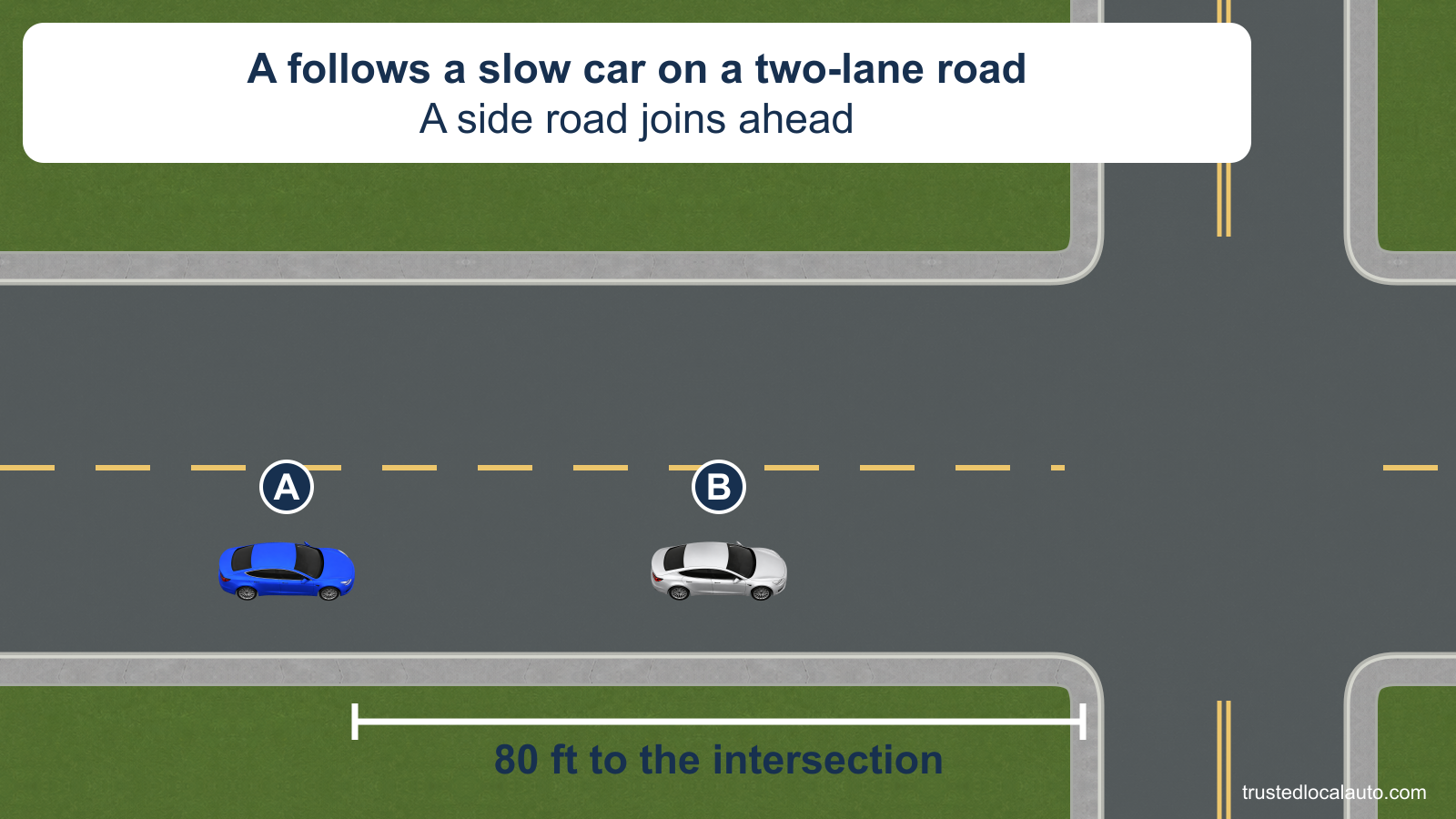
Correct answer: Only after you are through the intersection and the way ahead is clear.
Why
Vermont law does not allow a driver to pass another vehicle when approaching within 100 feet of an intersection or a railroad grade crossing, or while crossing it, unless traffic-control devices show otherwise. The manual also lists hills, curves, railroad crossings and intersections as places where you must not pass. Vehicles can enter from the side road or turn left there, and they do not expect a car in the oncoming lane.
Verified against Vermont Driver's Manual · No-passing zones · p. 53
Is this question correct and clear?
Continue learning
Related Vermont questions
- You wait on a two-lane road to turn left while oncoming traffic goes by. Which statement is correct?
- Think of the steering wheel as a clock face. Where does the Vermont manual recommend placing your hands for normal driving?
- You are in the right lane of two left-turn lanes. The street that you turn onto has two lanes going your way. Your destination is on the left side of that street, one block after the turn. How should you make the turn?
- On a road with one lane in each direction, the car ahead of you stops with its left signal on and waits for oncoming traffic before it turns left. What may you do?
- On a two-lane road, you stop to turn left and must wait for oncoming traffic to clear. How should your car be placed while you wait?
- You are in the right lane of a highway with two lanes going your way. Orange signs show that your lane will close ahead for road work, and no sign tells you where to merge. What should you do?