
Practice question, Question 1 of 20
Passing target: 80% (16/20)
You are driving at 30 mph and plan to turn right into a driveway ahead. Under Vermont law, when must your turn signal be on?
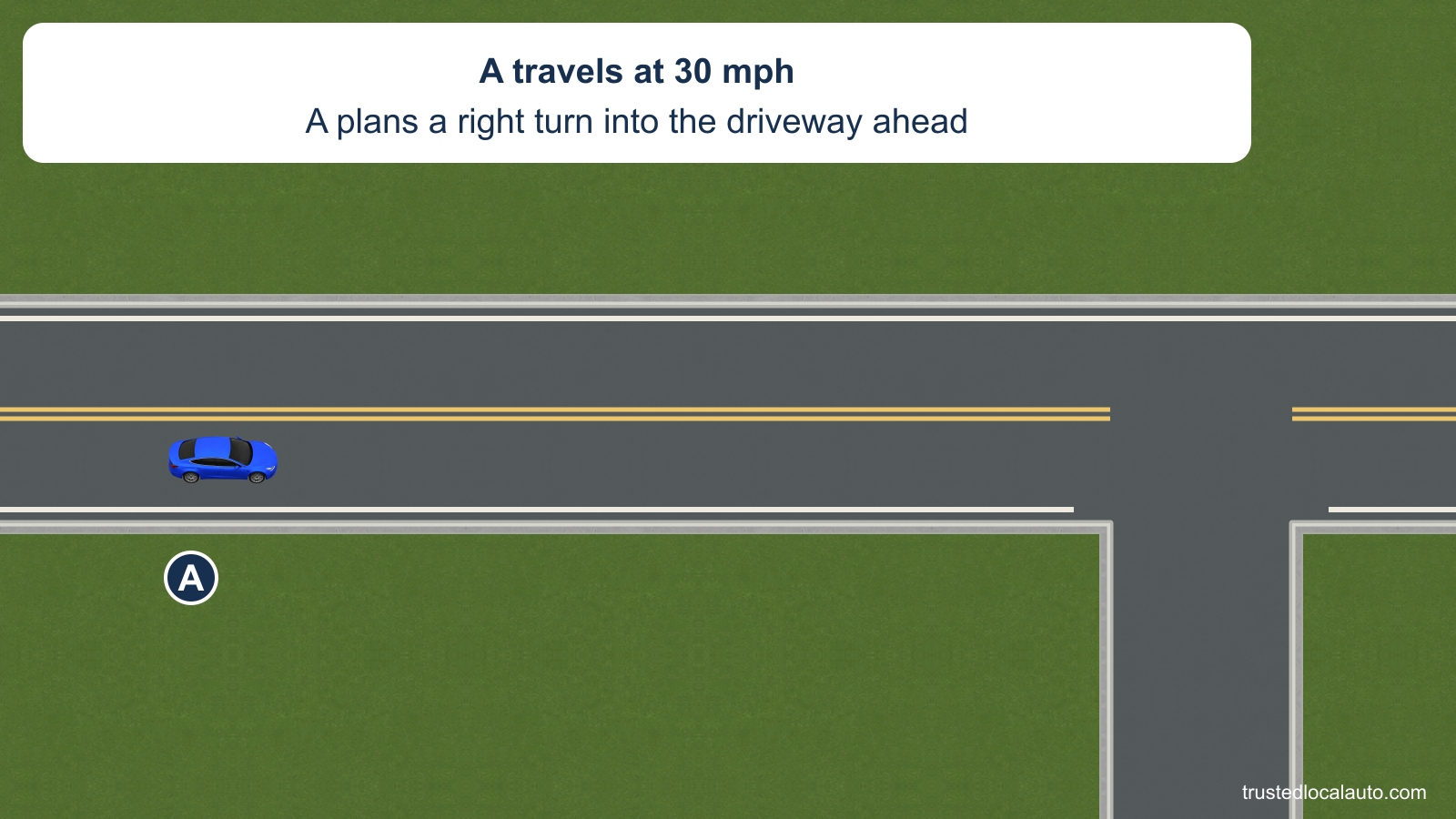
Correct answer: During at least the last 100 feet; a signal 3 to 5 seconds ahead meets this.
Why
Vermont law requires your turn signal to be on continuously for at least the last 100 feet before you turn, and you must also signal before you change lanes. The manual says that a signal 3 to 5 seconds ahead covers this rule. An early signal gives drivers behind you time to slow down before you brake, which helps prevent rear-end crashes. If your turn signals or brake lights do not work, use hand signals and have the lights fixed right away.
Verified against Vermont Driver's Manual · Signals · p. 27
Is this question correct and clear?
Continue learning
Related Vermont questions
- You wait on a two-lane road to turn left while oncoming traffic goes by. Which statement is correct?
- Think of the steering wheel as a clock face. Where does the Vermont manual recommend placing your hands for normal driving?
- You are in the right lane of two left-turn lanes. The street that you turn onto has two lanes going your way. Your destination is on the left side of that street, one block after the turn. How should you make the turn?
- On a road with one lane in each direction, the car ahead of you stops with its left signal on and waits for oncoming traffic before it turns left. What may you do?
- On a two-lane road, you stop to turn left and must wait for oncoming traffic to clear. How should your car be placed while you wait?
- You are in the right lane of a highway with two lanes going your way. Orange signs show that your lane will close ahead for road work, and no sign tells you where to merge. What should you do?