
Practice question, Question 1 of 20
Passing target: 80% (16/20)
On the interstate you drive in the lane next to a tractor-trailer, beside the middle of the trailer. You cannot see the truck's side mirrors. What does this tell you?
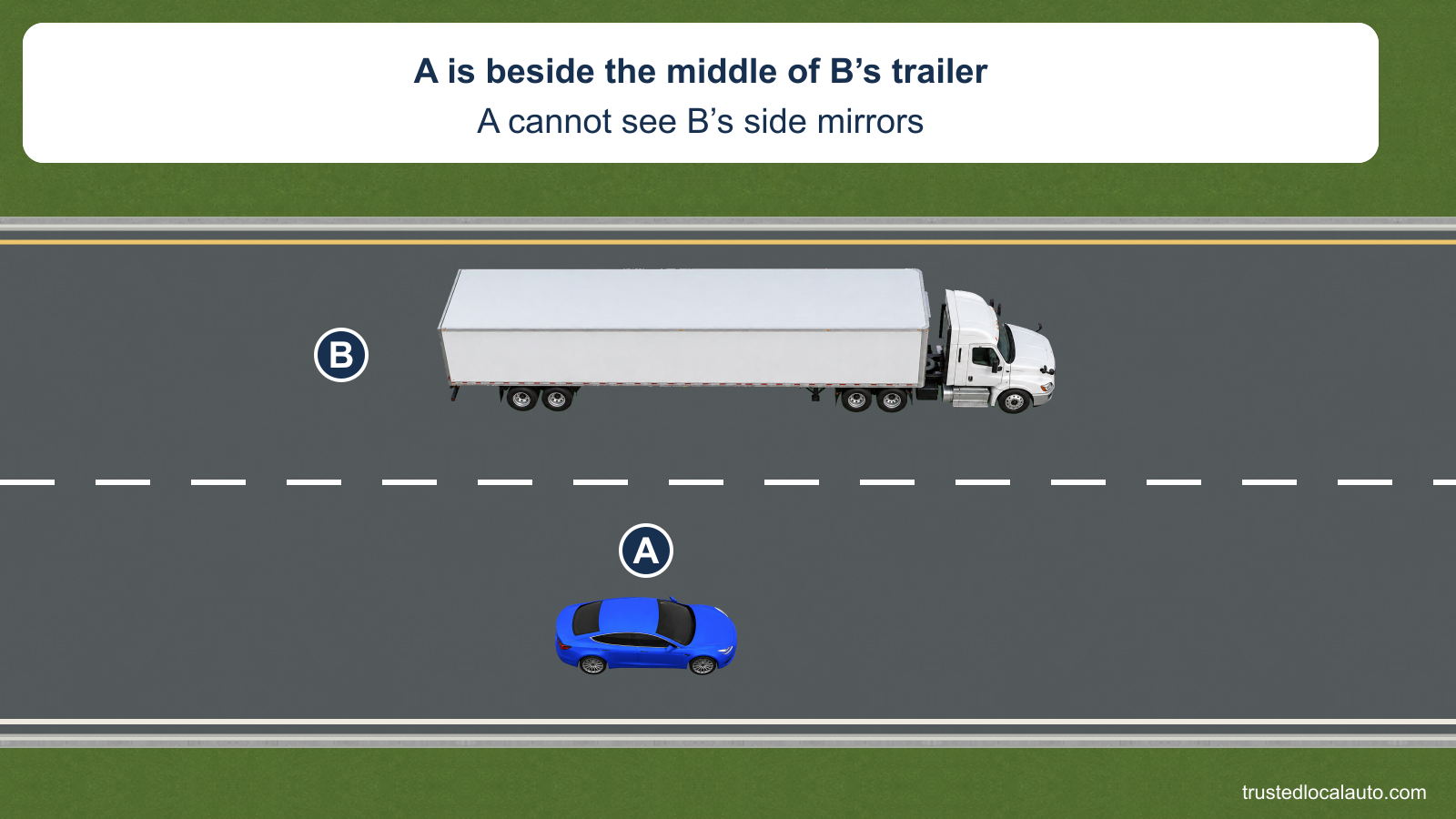
Correct answer: The truck driver probably cannot see you, so pass or drop back when it is safe
Why
Large trucks have blind spots, called No-Zones, at the front, at the back and on both sides. If the truck driver must change lanes quickly, a car in a side No-Zone can be hit. The bigger the truck, the bigger its blind spots, so spend as little time as possible beside it.
Verified against Vermont Driver's Manual · Sharing the Road with Large Trucks · p. 44, 45
Is this question correct and clear?
Continue learning
Related Vermont questions
- On a two-lane road you come up behind a person who rides a horse. The horse seems nervous. What should you do?
- Children were playing in the yard beside your driveway a few minutes ago. You now get into your car to back out. What is the safest plan?
- At an intersection with signals, a bicyclist in the roadway faces a steady red light, but the pedestrian signal for the same direction shows WALK. Under the Vermont law in force since July 1, 2026, what may the bicyclist do?
- On a narrow two-lane road, two bicyclists ride side by side in your lane. A curve ahead hides oncoming traffic. What should you do?
- You drive on a two-lane road and come up behind a bicyclist who rides near the right edge. The oncoming lane is clear, and you can see far ahead. How must you pass?
- On a road with two lanes in your direction, a motorcycle rides in the left part of your lane ahead of you. You want to pass it. What should you do?