
Practice question, Question 1 of 20
Passing target: 80% (16/20)
After a heavy storm, you reach a low spot where muddy water flows across the road. You cannot tell how deep it is, and no sign closes the road. What should you do?
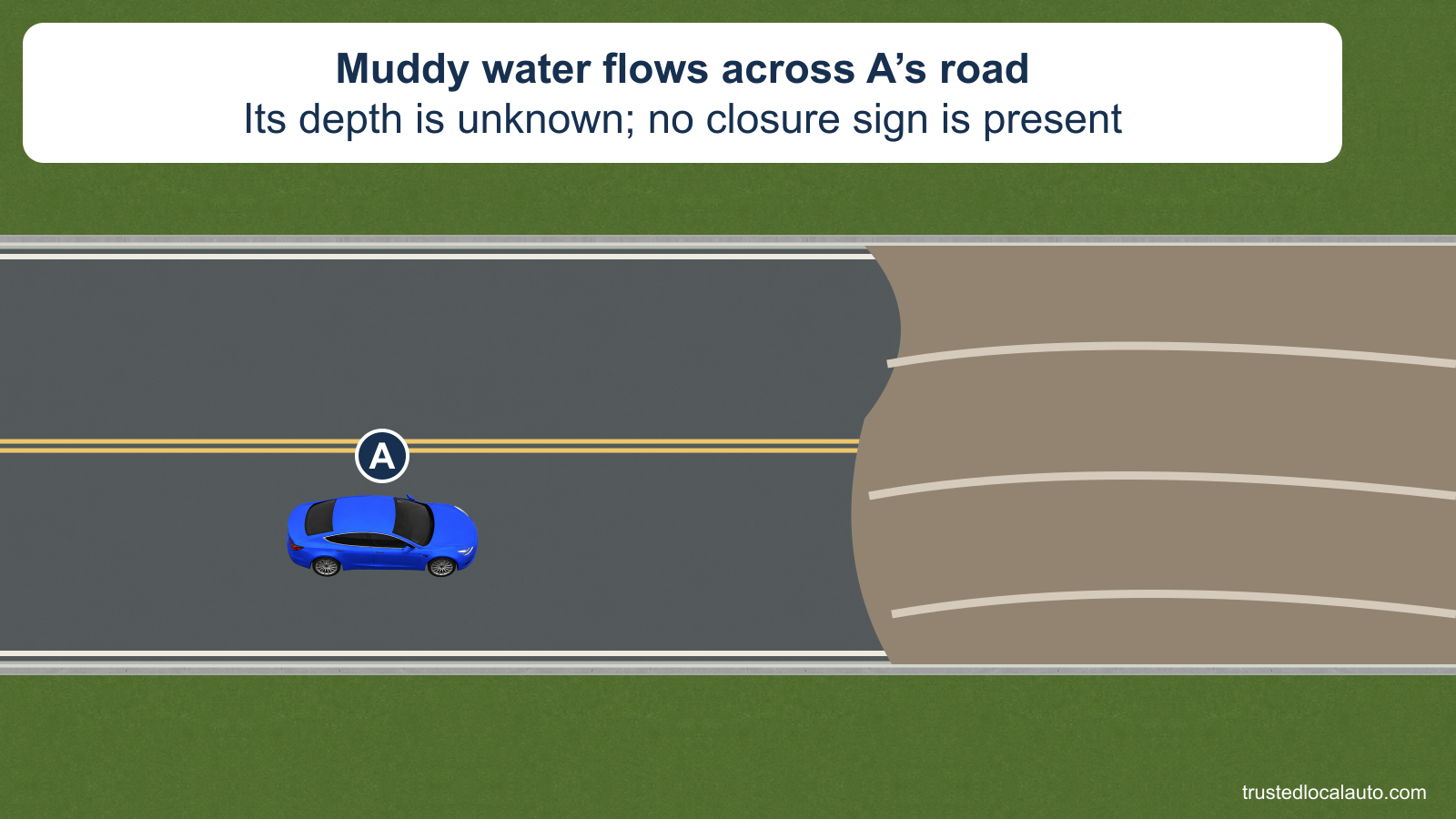
Correct answer: Turn around and use another route, because the water can hide a washed-out road.
Why
Nationally, flash floods kill more people than any other weather event, and nearly half of those deaths involve vehicles. Flood water can wash away or weaken bridges, culverts and roadbeds, and moving water can carry a car off the road. If a car ever stalls in a flooded area, the manual says to leave it as soon as possible, because the water can rise fast. Never drive around barricades or past a 'road closed' sign.
Verified against Vermont Driver's Manual · Floods and Storms · p. 47
Is this question correct and clear?
Continue learning
Related Vermont questions
- On a wet road, the traffic ahead of you stops suddenly, and you must brake hard. Your car has anti-lock brakes (ABS). What should you do?
- After a storm, a barricade and a sign stand at the start of a bridge on your usual route. The sign says the bridge is closed, but the bridge looks fine to you. What should you do?
- For a few days, you notice that your brake pedal goes down much farther than it used to before the car slows. What does the Vermont manual tell you to do?
- Sunset is at 7:10 p.m. You start driving at 7:45 p.m. on a clear evening, and it still seems fairly light outside. What does Vermont law require?
- On a wet road, the traffic ahead of you stops suddenly, and you must brake hard. Your car has anti-lock brakes (ABS). How should you use the brake pedal?
- On a clear morning, sunrise is at 6:20 a.m. You start to drive at 5:40 a.m., and it already looks fairly light outside. Which statement is correct?