
Practice question, Question 1 of 40
Passing target: 85% (34/40)
Driver A and Driver B reach an intersection with no signs or signals at the same time. Driver B comes from Driver A's right and will turn left across Driver A's path. Driver A will go straight. Which driver must yield?
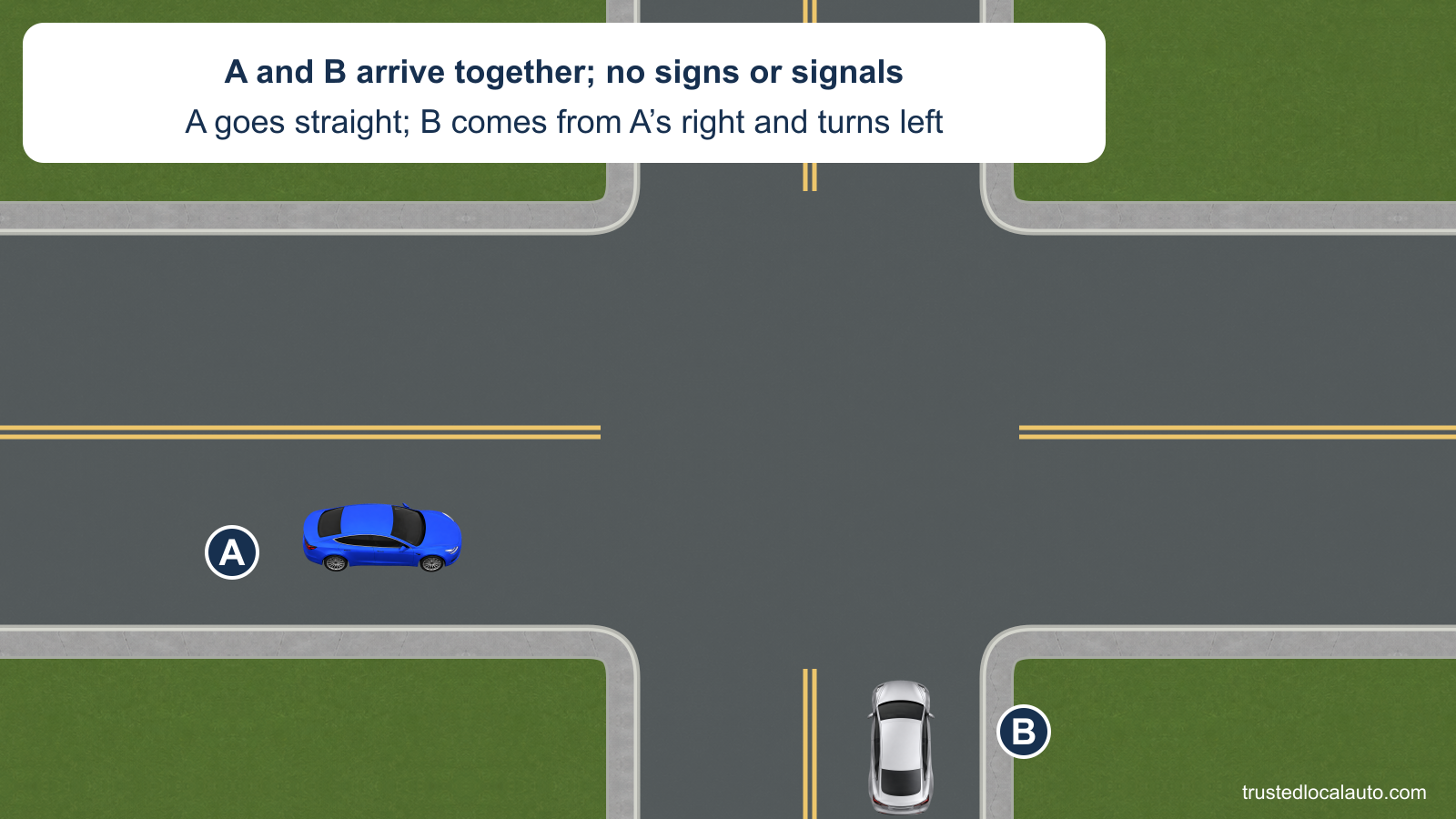
Correct answer: Driver A, because Driver B is on Driver A's right
Why
When drivers arrive at different times, the driver who arrives first goes first. The rule for the driver on the right applies when they arrive at about the same time. A driver who goes faster than the lawful speed loses any right-of-way (§ 46.2-823). If the other driver does not yield, let that driver go, because a crash is worse than a delay.
Verified against Virginia Driver's Manual · Yielding the Right-of-Way · p. 18
Is this question correct and clear?
Continue learning
Related Virginia questions
- You are in the middle of an intersection on a green light. An ambulance with a siren and flashing lights comes up behind you. What should you do?
- You come to a one-lane roundabout. A car in the circle approaches your entry point from your left, and a pedestrian has started to cross your approach road at the crosswalk. Who has the right-of-way?
- Your traffic light turns green. A funeral procession led by a police escort is still passing through the intersection in front of you. What should you do?
- The traffic lights at an intersection are dark because of a power failure. A police officer stands in the intersection and signals your lane to go through without a stop. What should you do?
- You drive out of a parking lot onto a city street. A sidewalk crosses the exit. No one is on the sidewalk, and no sign is posted at the exit. What must you do?
- You are stopped at a stop sign and are about to drive straight across a two-way street. In what order should you look for traffic?