
Practice question, Question 1 of 30
Passing target: 80% (24/30)
Two drivers park at the curb on a city street. No sign or painted curb gives other rules. The front of Driver A's car is 25 feet before a STOP sign at the side of the road. The nearest end of Driver B's car is 25 feet from a marked crosswalk at an intersection. Who parked legally?
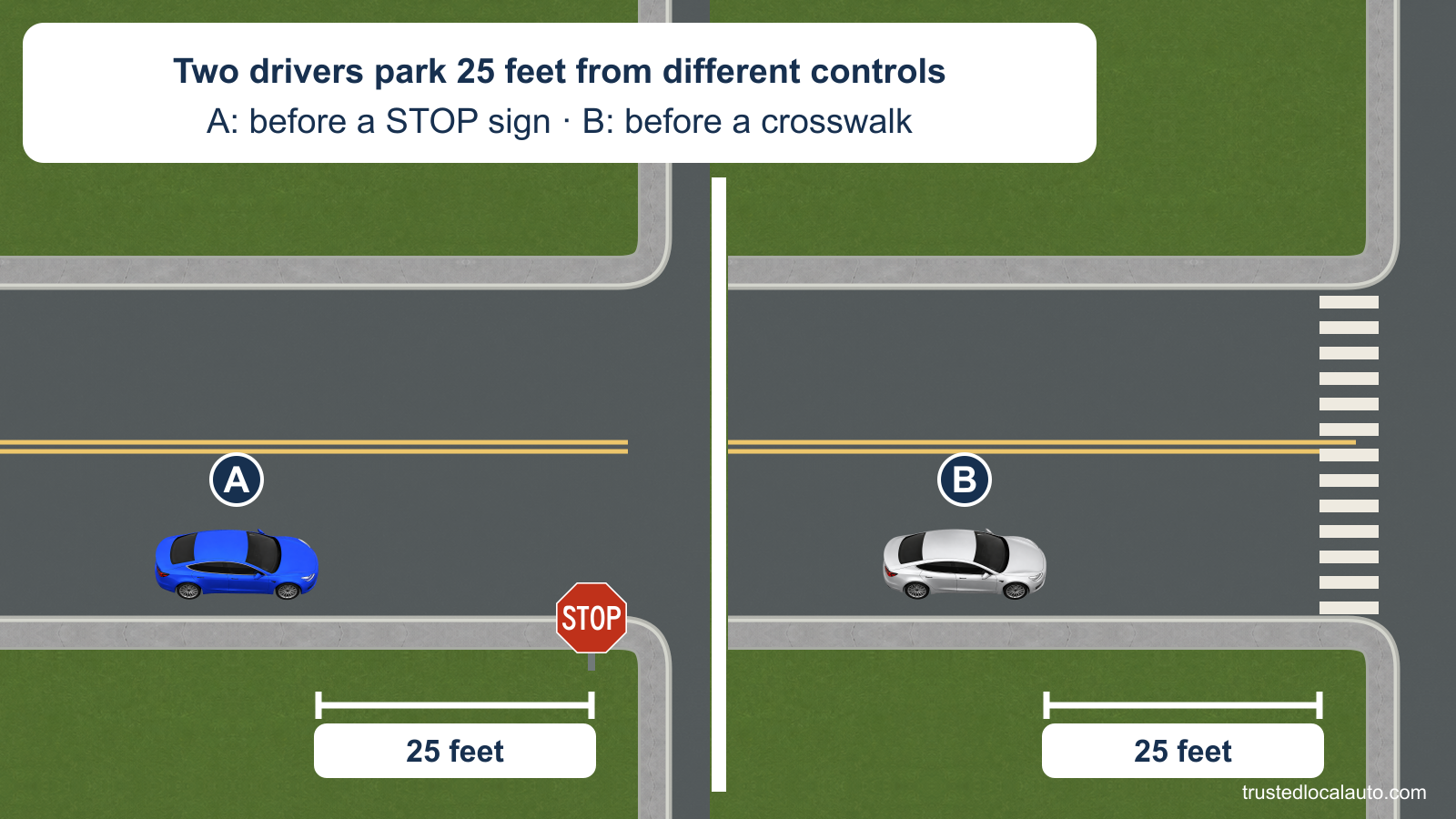
Correct answer: Only Driver B, because the limit is 30 feet for a STOP sign and 20 feet for a crosswalk.
Why
West Virginia law (17C-13-3) forbids stopping, standing or parking within 20 feet of a crosswalk at an intersection, and within 30 feet on the approach to a STOP sign, flashing beacon or traffic signal at the side of the road. A car parked closer can hide the sign or signal from other drivers, and it can hide people who step into the crosswalk. You also may not park on a crosswalk or within an intersection.
Verified against West Virginia Driver's Licensing Handbook · Prohibited Parking · p. 55
Is this question correct and clear?
Continue learning
Related West Virginia questions
- A parking space is marked with the wheelchair symbol. Which vehicle may park in it?
- You want to pull into an angle parking space on your right. How should you approach it?
- You parallel park so that your front bumper is 10 feet behind a fire hydrant. No sign or paint marks the curb. What is correct?
- Your car loses power in the right lane of an Interstate, but it can still roll. What should you do?
- You are parked at the right curb of a busy street and want to pull out. A car in the lane next to you is only a few car lengths behind you. What should you do?
- You parallel park on a busy street and want to get out on the driver's side. What should you do before you open the door?