
Practice question, Question 1 of 65
Passing target: 80% (52/65)
Driver A and Driver B drive the same model of car at 45 mph on the same dry road. Driver A watches the road ahead. Driver B looks down to change the radio station. A child runs into the road. Which statement is correct?
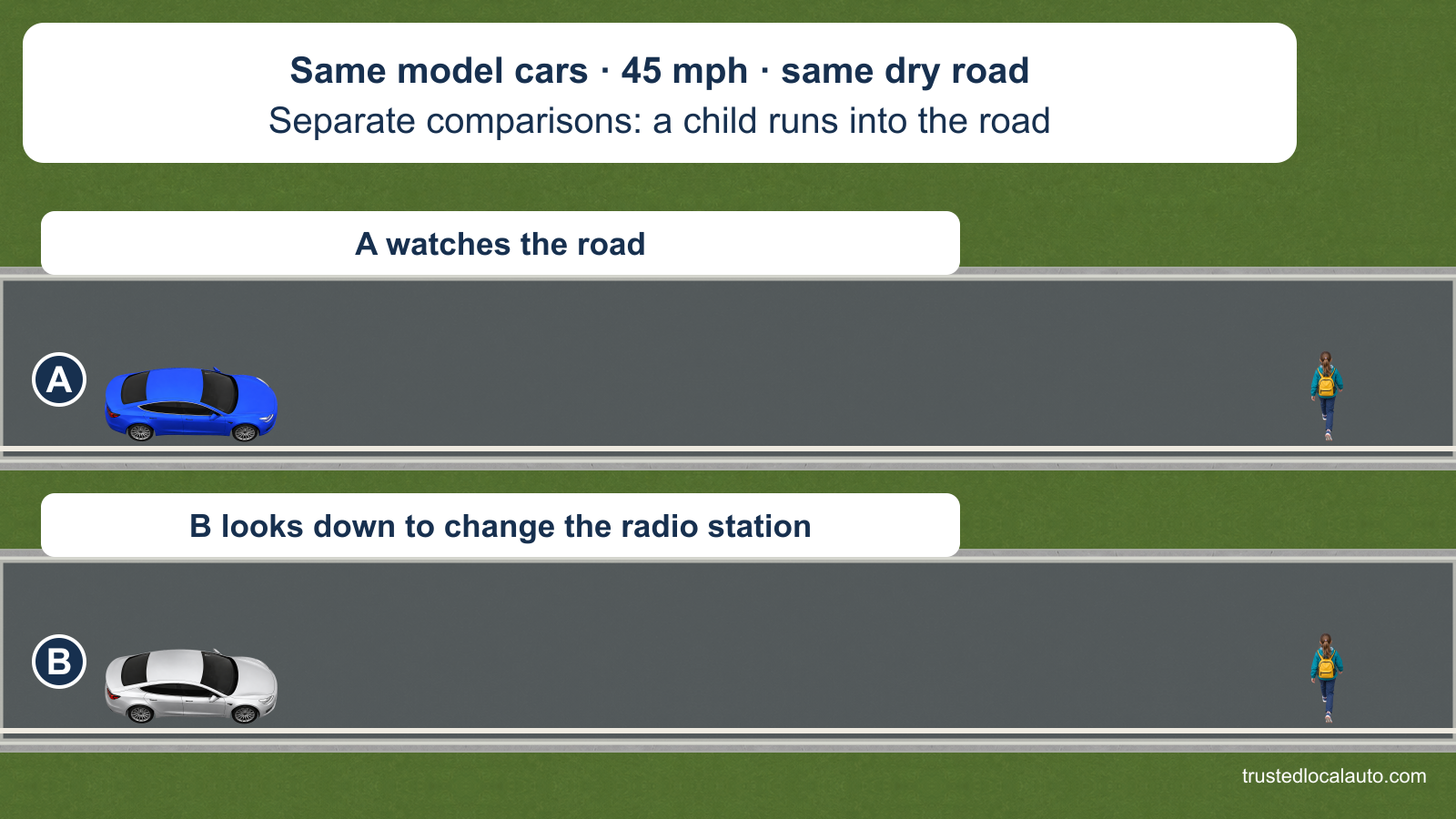
Correct answer: B needs more distance, because B notices the hazard later and travels farther before braking.
Why
Stopping distance is the distance you travel before you brake plus the distance you travel while the brakes slow the car. At 45 mph a car moves more than 60 feet each second, so a short look away adds a long distance.
Verified against Wisconsin Motorists' Handbook · Braking and stopping · p. 16, 15, 53
Is this question correct and clear?
Continue learning
Related Wisconsin questions
- You drive on a street in an outlying part of a Wisconsin city, not in a residential area. No sign shows a speed limit, and no school is near. What is the highest speed that you may drive?
- It is snowing, and traffic is heavier than usual. You use the handbook's four-second rule and add time for each bad condition. What is the shortest following time that the rule gives?
- You drive in snow, and traffic is heavy. Then the snow stops and the road is dry, but traffic is still heavy. You use the handbook's four-second rule and add time for each bad condition. What is the shortest following time now?
- It is raining, and traffic is heavy. You use the handbook's four-second rule and add time for each bad condition. What is the shortest following time that the rule gives?
- The car ahead passes a mailbox, and you start to count: “one thousand one, one thousand two...” Your front bumper reaches the mailbox as you say “one thousand two.” The road is dry and traffic is light. What does this tell you?
- At night on an unlit rural road, your low beams light only a short part of the road ahead. The posted limit is 55 mph, and an oncoming car is about 400 feet away. What should you do about your speed?