
Back to Nevada
Nevada Class C Instruction Permit Practice Test
Full test preview Question 1 of 25
0 answered 25 remaining
Passing target: 80% (20/25)
Observation, Speed & SpaceStandalone practice
A steady rain has made the road wet. Compared with a dry road, how should you set your following distance?
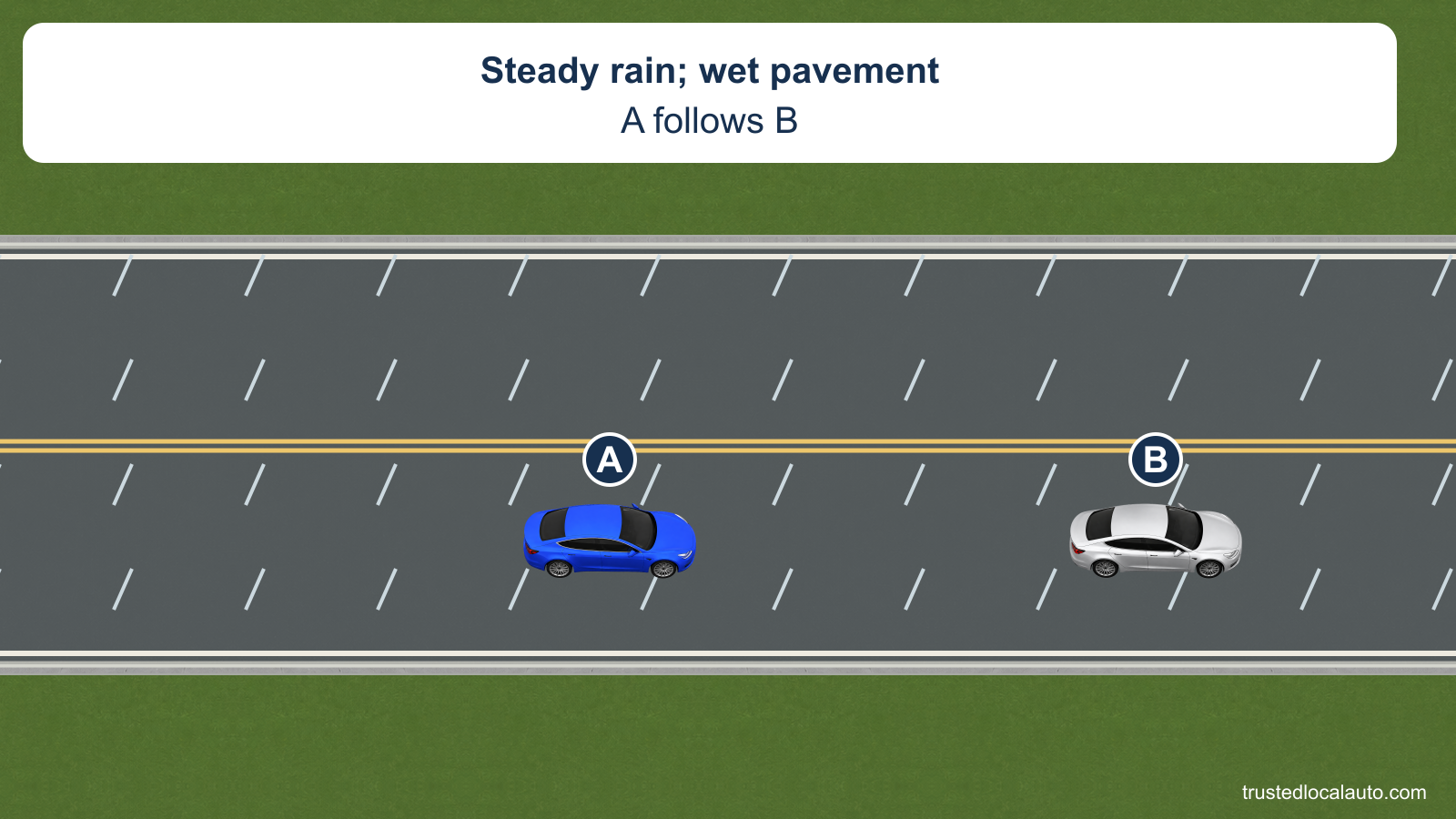
A follows B on a two-way road in steady rain. The pavement is wet.
Correct answer: Make the gap larger, because wet pavement can more than double your stopping distance.
Why
The two-second gap in the handbook is a minimum for good conditions at 40 mph or less. When the road is slippery or you cannot see well, use a larger gap and a lower speed. In heavy rain, many cars can start to hydroplane at 35 to 55 mph, so slowing down also helps the tires stay in contact with the road.
Verified against Official Nevada Driver Handbook · Stopping · p. 41, 42
Report a question issueContinue learning
Related Nevada questions
A yellow warning sign shows a sharp curve ahead on a two-lane road. When should you slow down?You are backing out of an angled parking space on a downtown street. As your car starts to move, you see a bicyclist coming up the street and a pedestrian about to walk behind your car. What should you do?You drive at 35 mph on a dry street. The car ahead passes a signpost, and your front bumper reaches the same post as you finish saying "one thousand one." What does this tell you?You drive on a residential street with cars parked on both sides. A ball rolls into the street from between two parked cars. What should you do?On a dry, level road, you speed up from 35 mph to 70 mph. About how long is your braking distance now, compared with before?On a highway with two lanes in your direction, you have driven next to another car for some time. What should you do?