
Practice question, Question 1 of 20
Passing target: 80% (16/20)
You plan to leave an expressway at the next exit, which has a deceleration lane. Traffic around you moves at 70 mph. Where should you do most of your slowing?
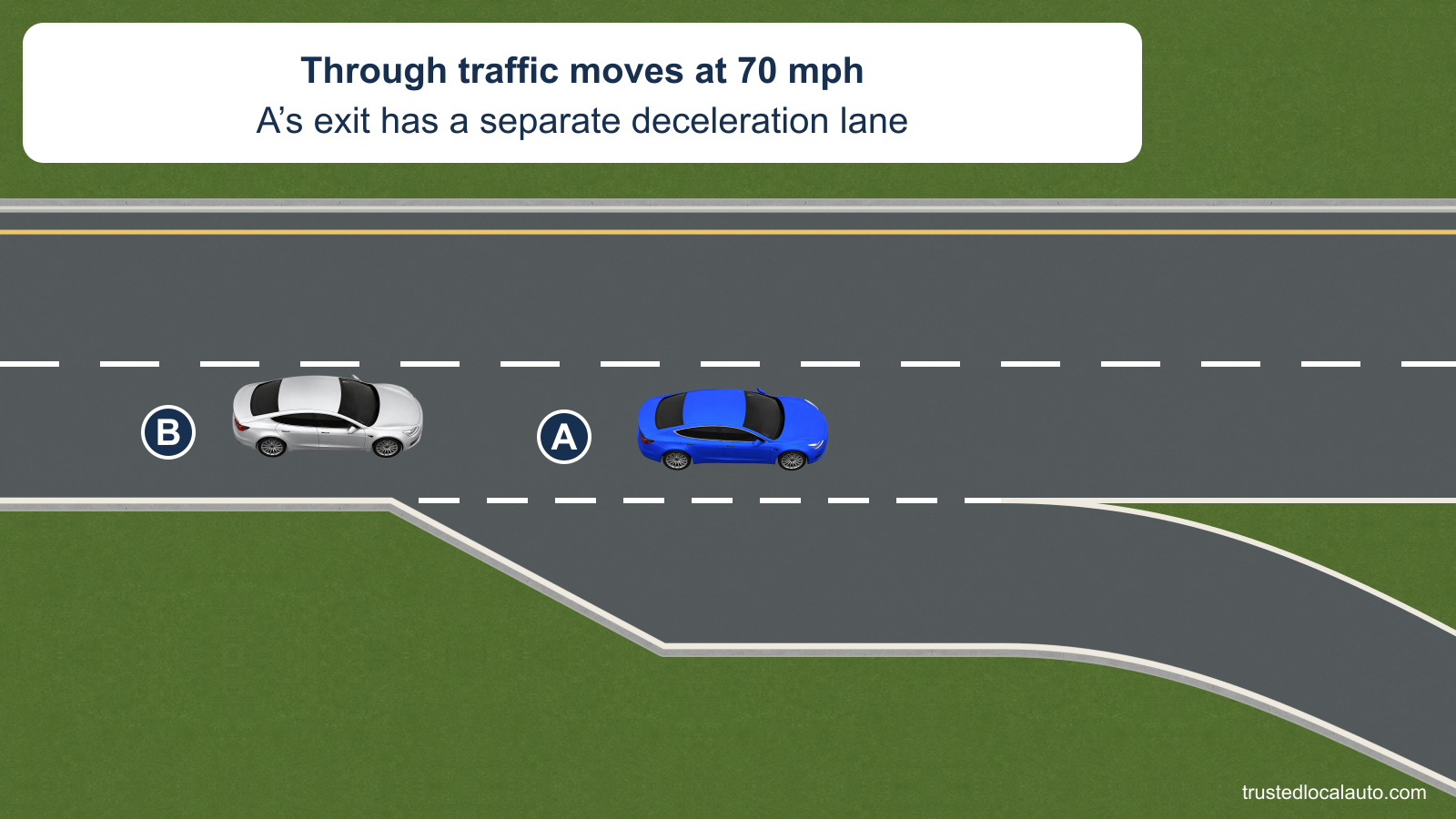
Correct answer: In the deceleration lane after you move into it, and then on the exit ramp
Why
Braking in a through lane at expressway speed invites a rear-end crash, because the drivers behind you do not expect a car to slow there. Keep up with the flow of traffic until you reach the exit, and signal right at least 100 feet before it. After you move into the deceleration lane, slow down there and keep slowing on the ramp until you reach the posted ramp speed. Check your speedometer.
Verified against Oklahoma Driver Manual · Expressway driving: leaving the expressway · p. 34
Is this question correct and clear?
Continue learning
Related Oklahoma questions
- You drive down an entrance ramp into the acceleration lane of an expressway. Traffic in the right lane moves at about 65 mph. What should you do?
- You drive in the left lane of a three-lane expressway in heavy traffic. A sign shows that your exit, on the right, is 1 mile ahead. What should you do?
- Your car loses power on an expressway at dusk. You signal and steer it onto the far right shoulder. Two children ride in the back seat. What should you do next?
- On a city street at 30 mph, you keep a gap that lets you stop in time. Later you drive at 60 mph on an expressway in the same conditions. How does your total stopping distance change?
- In the manual's stopping-distance chart, your speed goes from 30 mph to 60 mph. How do the reaction distance and the braking distance change?
- You drive in the right lane of an expressway through an interchange. A car in the acceleration lane on your right signals and tries to merge. The lane on your left is clear. What should you do?