
Oklahoma Class D Knowledge Test Practice
Full test preview Question 1 of 20
0 answered 20 remaining
Passing target: 80% (16/20)
On a city street at 30 mph, you keep a gap that lets you stop in time. Later you drive at 60 mph on an expressway in the same conditions. How does your total stopping distance change?
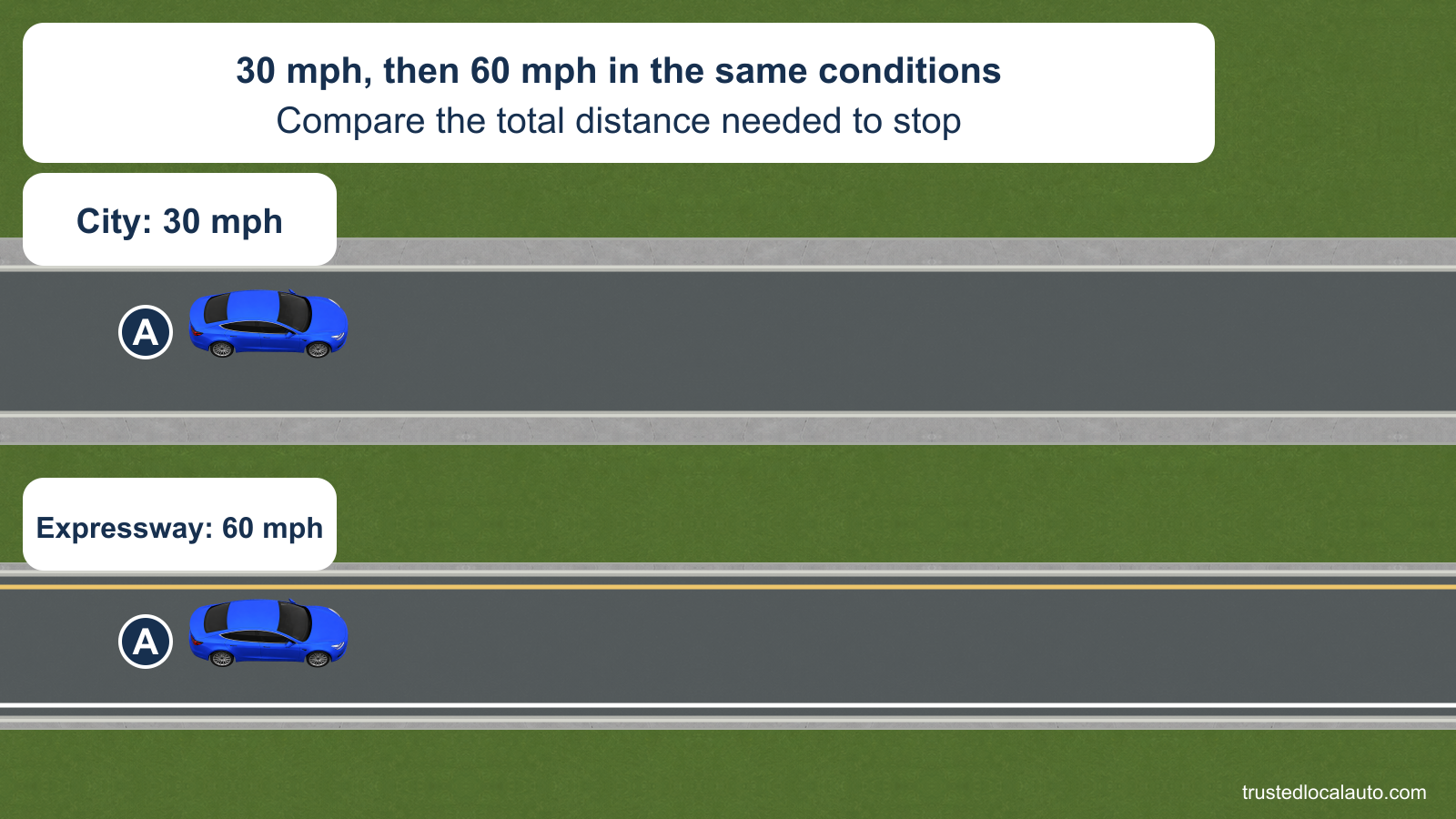
Two separate views show the same blue car A, first on a city street at 30 mph and later on an expressway at 60 mph. The card states that the conditions are the same; no stopping-distance values appear.
Correct answer: It more than doubles, because braking distance grows much faster than speed
Why
Your reaction distance grows in step with your speed: in the manual's chart it is 66 feet at 30 mph and 132 feet at 60 mph. Braking distance grows much faster, from about 33 to 50 feet to about 120 to 240 feet. So the total stopping distance at 60 mph (about 252 to 372 feet) is well over twice the distance at 30 mph (about 99 to 116 feet). At expressway speed, you need a much larger gap. A gap that you count in seconds grows by itself as your speed goes up.
Verified against Oklahoma Driver Manual · Stopping distance · p. 42
Report a question issueContinue learning