
Practice question, Question 1 of 40
Passing target: 16 correct signs and 16 correct rules (Trusted Local Auto practice targets)
On an Ontario highway with at least two lanes in your direction, you approach a stopped emergency vehicle or tow truck from the lane beside it. The emergency vehicle has flashing red or red-and-blue lights; a tow truck has flashing amber lights. What must you do?
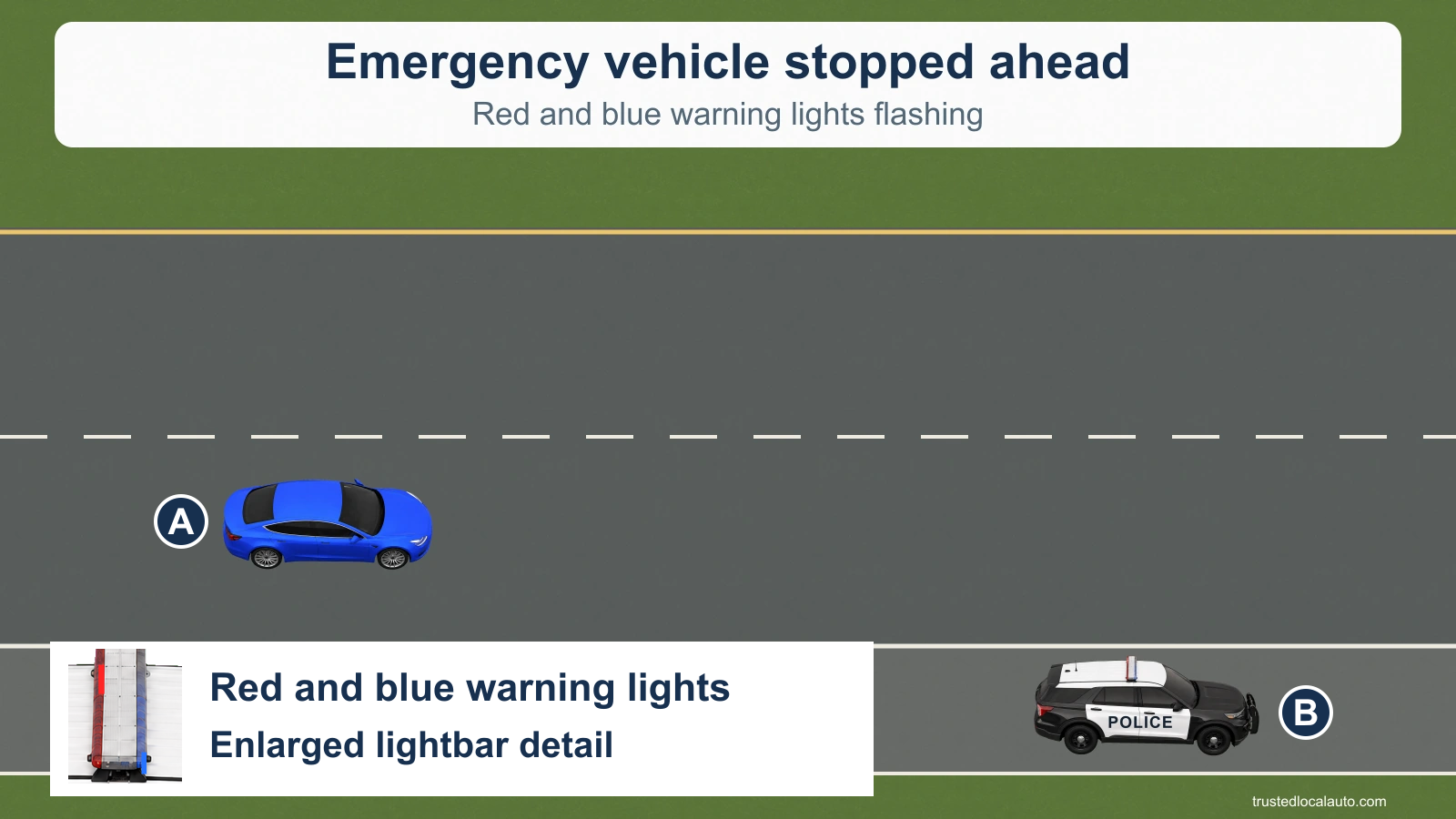
Correct answer: Slow down with caution and move over a lane if safe.
Why
Slow down and proceed cautiously, taking account of traffic, road and weather conditions. On a highway with at least two lanes in your direction, a driver approaching in the stopped vehicle’s lane or an adjacent lane must move into another lane if this can be done safely. If a lane change is unsafe, continue cautiously without forcing it. A safe stop is permitted. The law does not prescribe a fixed speed reduction below the posted limit.
Verified against Highway Traffic Act, R.S.O. 1990, c. H.8 · Approaching stopped emergency vehicles and tow trucks
Is this question correct and clear?
Continue learning
Related Ontario questions
- When you approach a streetcar that is stopped to let passengers on or off, and there is no safety island, you must:
- When approaching a railway crossing with flashing red lights and a lowering gate, when are you legally allowed to cross?
- You approach a railway crossing with its warning lights flashing and gates lowered. What should you do?
- You are in the lane beside a stopped emergency vehicle with flashing red or red-and-blue lights. The Ontario highway has at least two lanes in your direction. What does the move-over rule require?
- What is a "blind spot"?
- A highway railway crossing has no gates, no railway signal lights and no STOP sign. No train is approaching and no flagperson is there. Which statement about a stop at least 5 metres from the nearest rail is correct?