
Back to Ontario
Ontario G1 Practice Test
Full test preview Question 1 of 40
0 answered 40 remaining
Passing target: 16 correct signs and 16 correct rules (TLA practice targets)
Pedestrians, cyclists, school buses and other road usersStandalone practice
By law, how far must you stop from the nearest rail of a railway crossing when the warning signals are flashing?
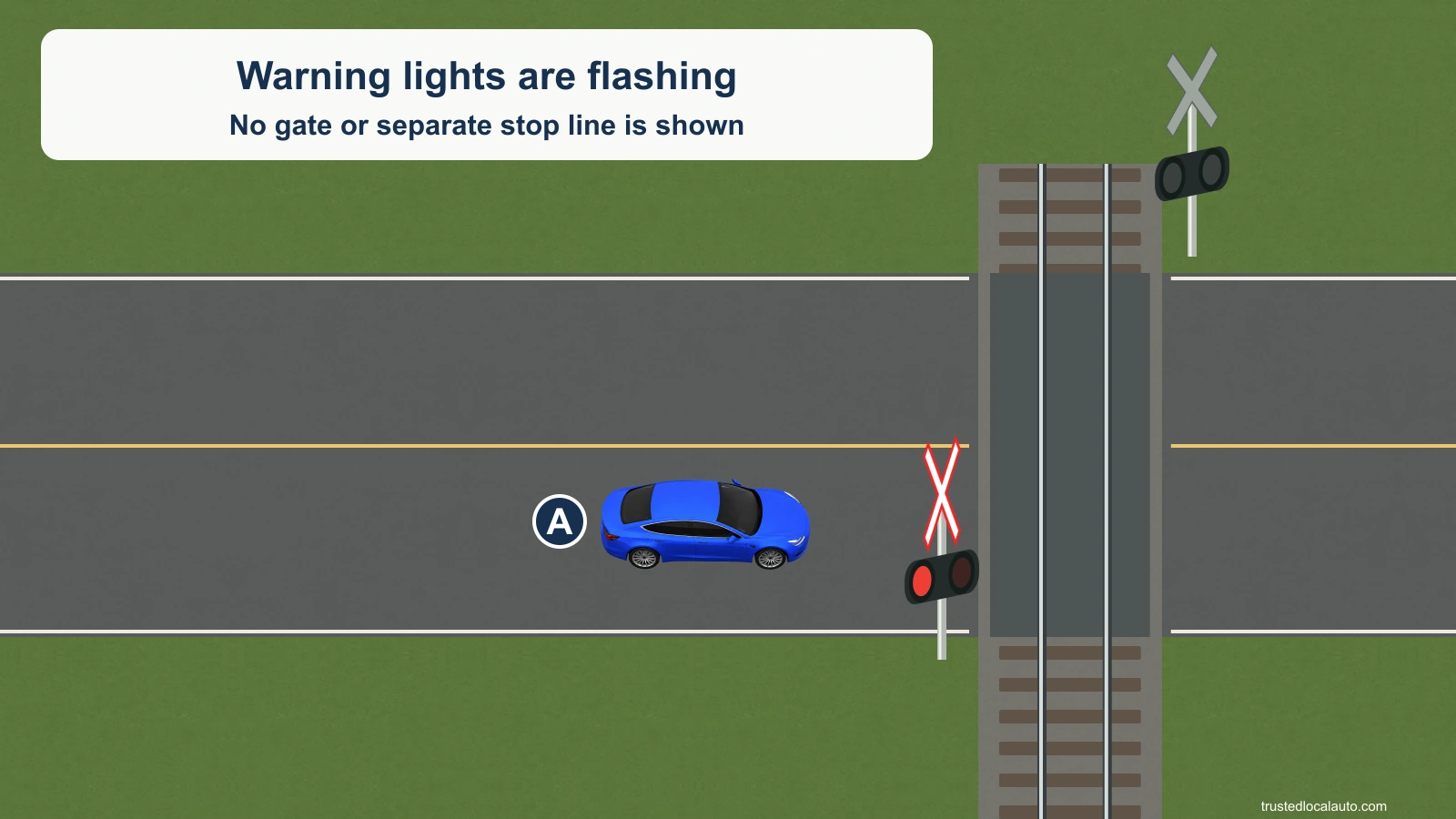
Blue car A faces east before a single-track railway crossing. The warning signal is active; one red lens represents an instant in its flashing cycle. No gate or separate stop line is shown.
Correct answer: At least 5 metres
Why
When approaching a railway crossing where the signal lights are flashing or a train is approaching, you must stop at least 5 metres from the nearest rail.
Verified against The Official Ministry of Transportation (MTO) Driver’s Handbook · Intersections, railway crossings, school crossings and school buses · p. 48, 56
Report a question issueContinue learning
Related Ontario questions
When you approach a streetcar that is stopped to let passengers on or off, and there is no safety island, you must:When approaching a railway crossing with flashing red lights and a lowering gate, when are you legally allowed to cross?You approach a railway crossing with its warning lights flashing and gates lowered. What should you do?You are in the lane beside a stopped emergency vehicle with flashing red or red-and-blue lights. The Ontario highway has at least two lanes in your direction. What does the move-over rule require?On an Ontario highway with at least two lanes in your direction, you approach a stopped emergency vehicle or tow truck from the lane beside it. The emergency vehicle has flashing red or red-and-blue lights; a tow truck has flashing amber lights. What must you do?What is a "blind spot"?