
Practice question, Question 1 of 18
Passing target: 83.3% (15/18)
You are driving behind a school bus that has no students on board. The bus is near a railroad crossing that has no lights or gates, and you see no train. What should you expect the bus to do?
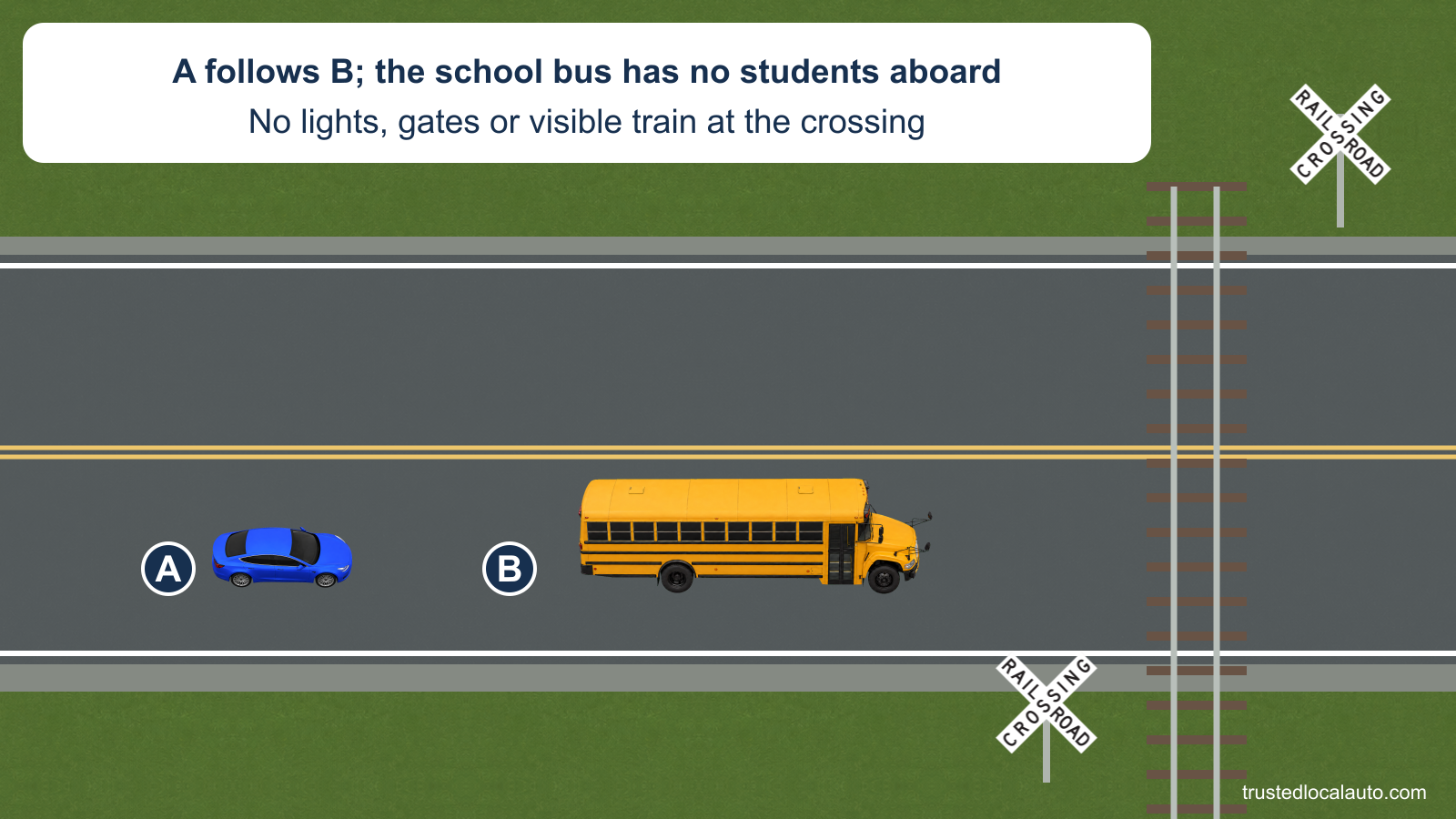
Correct answer: Stop 15 to 50 feet from the nearest rail before it crosses the tracks.
Why
Some vehicles must stop at every railroad crossing, even when no train or signal is present. In Pennsylvania these include school buses, buses that carry passengers, and trucks that carry fuel or other hazardous materials. When you follow one of these vehicles, keep a longer following distance so that you can stop smoothly behind it.
Verified against Pennsylvania Driver's Manual · Managing Space; Railroad Crossings · p. 40, 59
Is this question correct and clear?
Continue learning
Related Pennsylvania questions
- A train has just gone through a railroad crossing. The gates start to rise, but the red lights still flash. What should you do?
- The normal speed limit on a highway is 55 mph. At the start of an active work zone, a sign shows a 45 mph limit. Workers are next to your lane, and the lanes are narrow. What speed should you drive?
- You drive behind a school bus on an undivided two-lane road. The bus is still moving, and its amber (yellow) lights start to flash. What should you do?
- You come to an intersection in a work zone. The traffic signal for your lane is green. A flagger in a reflective vest faces you and holds up a STOP paddle. What should you do?
- Your car stalls on a railroad crossing. The crossing lights start to flash, and you hear a train horn. What should you do?
- You drive on a two-lane road with no median. Ahead, a school bus stops in the oncoming lane. Its red lights flash, and its stop arm is out. What must you do?