
Back to Tennessee
Tennessee Class D Knowledge Test Practice
Full test preview Question 1 of 40
0 answered 40 remaining
Passing target: 80% (32/40)
Weather, Visibility & EmergenciesStandalone practice
At dusk on a two-lane road, a deer steps into your lane close ahead. A car comes toward you in the other lane, and you cannot stop in time. What gives you the best chance of avoiding serious injury?
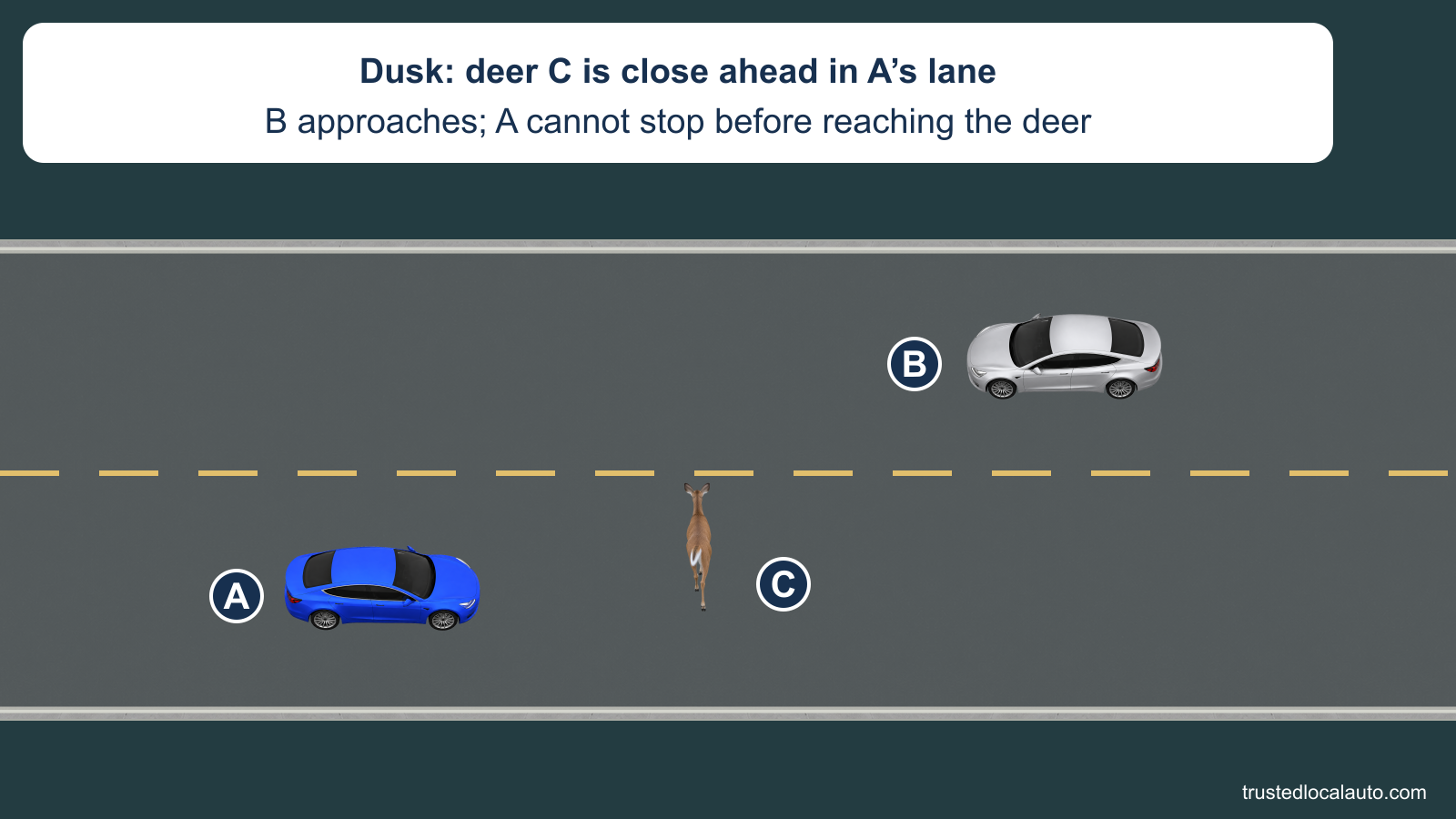
At dusk, deer C stands close ahead of blue A in its lane while silver B approaches in the other lane.
Correct answer: Brake firmly, keep control of the car in your own lane, and do not swerve.
Why
Deer are most active at dawn and dusk and in the fall, and where you see one deer there are often others. Scan the road edges for eyes that shine in your headlights, and use high beams when no car is near. Report a crash with a deer or a farm animal to the police.
Verified against Tennessee Comprehensive Driver License Manual · Collisions With Animals — Deer in the road · p. 111
Report a question issueContinue learning
Related Tennessee questions
Your car does not have antilock brakes. On an icy road you brake to stop, and the wheels lock. The car slides straight ahead and does not respond when you steer. What should you do?It is 2 p.m., and a steady drizzle makes you run your windshield wipers all the time. You can still see well. What does Tennessee law say about your headlights?It has not rained for two weeks. As you drive, a light rain starts to fall. When is the road likely to be the most slippery?After a heavy storm, water flows across a low spot in the road ahead. It looks only a few inches deep, and a pickup truck just drove through it. What should you do?On a dark two-lane road, an oncoming truck has very bright headlights. Where should you look until the truck passes?At 10 a.m., you drive into thick fog on a highway. Your car has daytime running lights, parking lights, fog lights and headlights. Which lights should you use?