
Practice question, Question 1 of 40
Passing target: 80% (32/40)
On the interstate, you drive beside a tractor-trailer, next to the middle of the trailer. You cannot see the truck's side mirrors. What does this tell you, and what should you do?
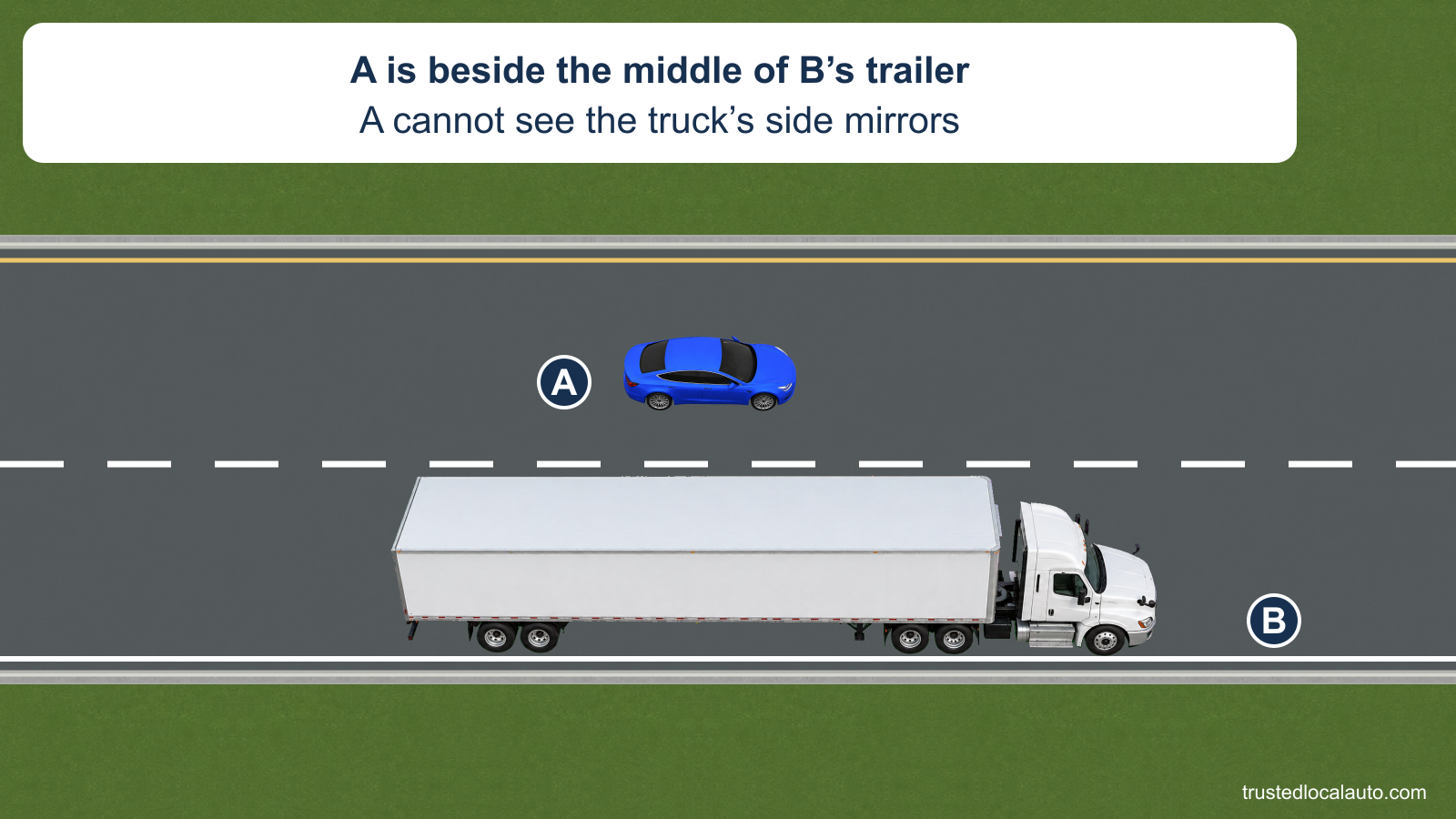
Correct answer: The driver probably cannot see you, so pass quickly or drop back.
Why
Large trucks have No-Zones in front, behind and on both sides, and the side blind spots are much larger than a car's. A simple check: if you cannot see the truck's side mirror, the driver cannot see you. Pass trucks without delay, and do not travel next to any vehicle at the same speed.
Verified against Tennessee Comprehensive Driver License Manual · Sharing the Road with Large Trucks and Buses — No-Zones · p. 123, 124, 78
Is this question correct and clear?
Continue learning
Related Tennessee questions
- You are in the right lane and plan to turn right at the next corner. A bicyclist rides straight ahead on your right, near the curb, and will reach the intersection at about the same time as you. What should you do?
- On a two-lane road, you come up behind a bicyclist. An oncoming car is near. If you pass now, there is room for only about 2 feet between your car and the bicycle. Which statement is correct?
- On a city street with no parked cars, a bicyclist rides at the right edge of your lane. Ahead of the rider, a large pothole lies near the edge, and the rider moves toward the middle of the lane to go around it. What should you do?
- On a narrow city street, a bicyclist rides near the middle of your lane, not at the right edge. Cars are parked along the right side of the street. What should you do?
- You drive on a city street at 30 mph. Ahead, an older man walks unsteadily toward the curb in the middle of the block, far from any crosswalk. He looks as if he may step into the street. What should you do?
- You follow a motorcycle on a two-lane road. Ahead is a railroad crossing with rough tracks. What should you do?