
Vermont Operator License Permit Practice Test
Full test preview Question 1 of 20
0 answered 20 remaining
Passing target: 80% (16/20)
Driver A drives north. Driver B drives west and approaches from Driver A's right. They reach a crossroads that has no signs, signals or officer at about the same time. Both will go straight. Who must yield?
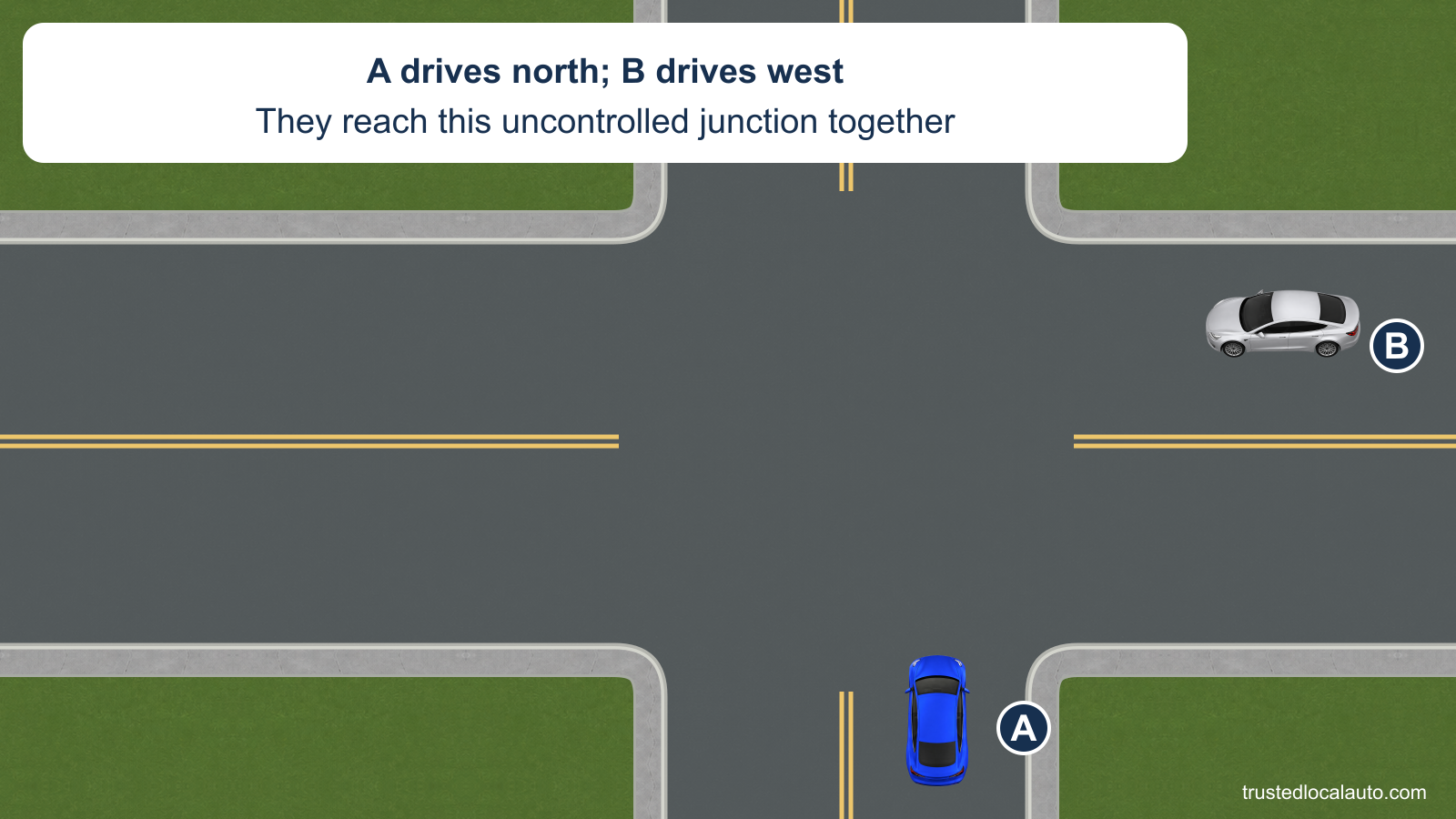
A faces north on the south approach, while silver B faces west on the east approach. The intersection has no signs or signals and neither car is in its center.
Correct answer: Driver A, because the driver on the left yields to the driver on the right.
Why
When two vehicles come from different roads and reach an intersection at about the same time, Vermont law requires the driver on the left to yield to the driver on the right. This rule applies where no sign, signal or officer controls traffic, and the manual gives the same rule for two vehicles that arrive together at a four-way stop. All drivers must still approach such an intersection slowly and with care, and must yield to pedestrians, bicyclists and traffic already in the intersection.
Verified against Vermont Driver's Manual · Right-of-way · p. 29
Report a question issueContinue learning