
Practice question, Question 1 of 65
Passing target: 80% (52/65)
Your car has anti-lock brakes (ABS). On a wet road, the car ahead stops suddenly, and you brake hard. The brake pedal starts to pulse under your foot, and you hear a grinding noise. What should you do?
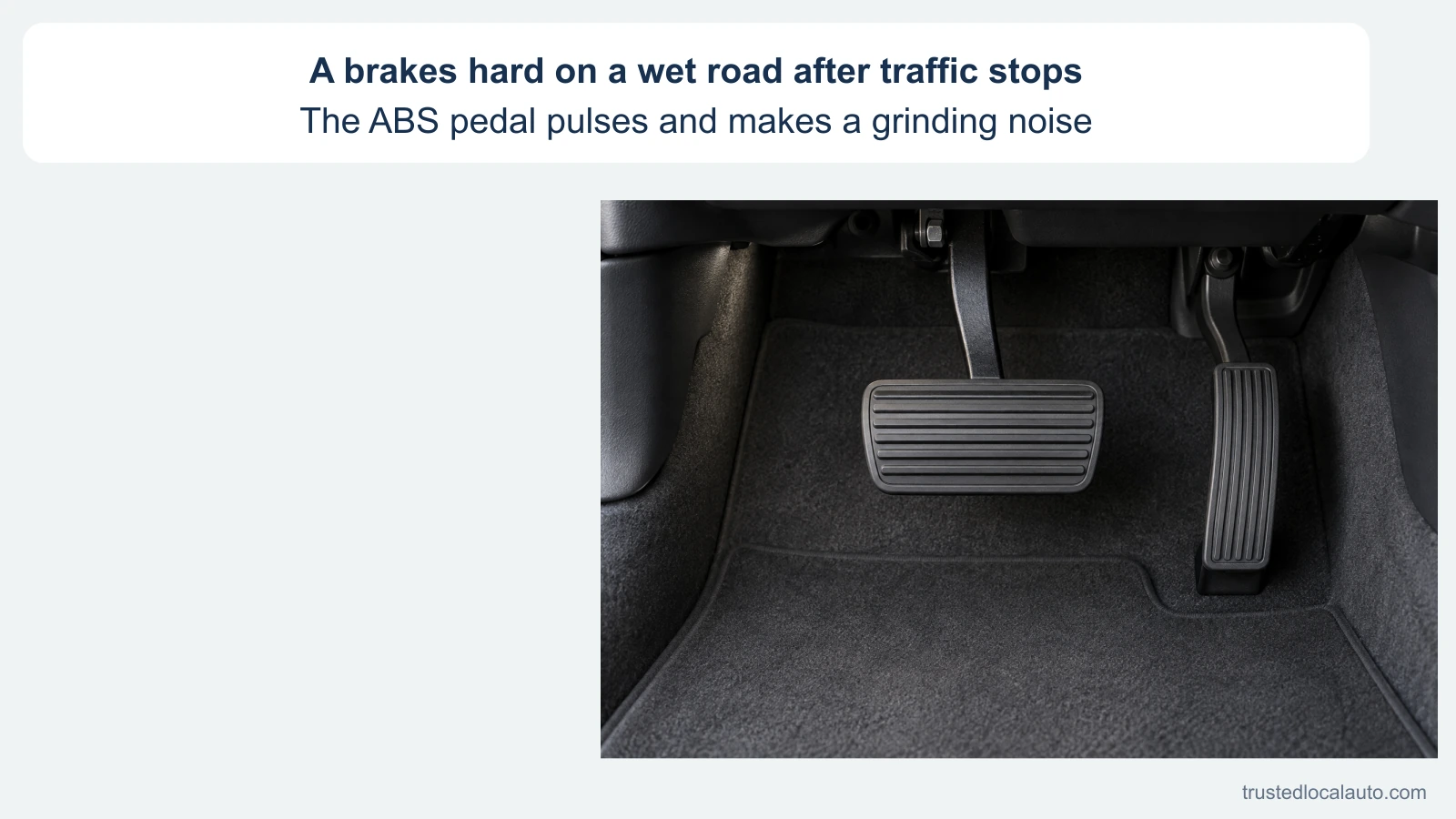
Correct answer: Keep firm, steady pressure until you stop, because the pulse means that ABS is working.
Why
ABS applies and releases the brakes for you many times each second. When it works, you can feel a pulse in the pedal and hear a noise, and the car stops with little or no skidding. Keep your foot down firmly, and steer around the hazard if you need to. Also watch the traffic behind you, because a quick stop can cause a crash from behind.
Verified against Wisconsin Motorists' Handbook · Avoiding crashes (emergency braking with ABS) · p. 50, 48
Is this question correct and clear?
Continue learning
Related Wisconsin questions
- Just after sunset on a rural road, you see a pair of eyes shine in your headlights near the ditch ahead. It looks like a deer. What should you do?
- Your car has anti-lock brakes (ABS). On a wet road, the car ahead stops suddenly, and you brake hard. The brake pedal starts to pulse under your foot, and you hear a grinding noise. What should you do?
- You drive on a city street and press the brake pedal. The pedal sinks to the floor, and the car does not slow down. What should you do first?
- Your older car does not have an anti-lock braking system (ABS). On an icy road, you must slow down quickly for stopped traffic ahead. How should you brake?
- On a highway with a 55 mph speed limit, you come up behind a snowplow that is spreading salt. Its warning lights flash. What is the closest that you may follow it?
- You can see clearly for more than 500 feet. During which period does Wisconsin law still require your headlights to be on?