
Practice question, Question 1 of 40
Passing target: 80% (32/40)
You drive with your high beams on along a dark rural road. A car comes toward you from the opposite direction. At the latest, when must you switch to low beams?
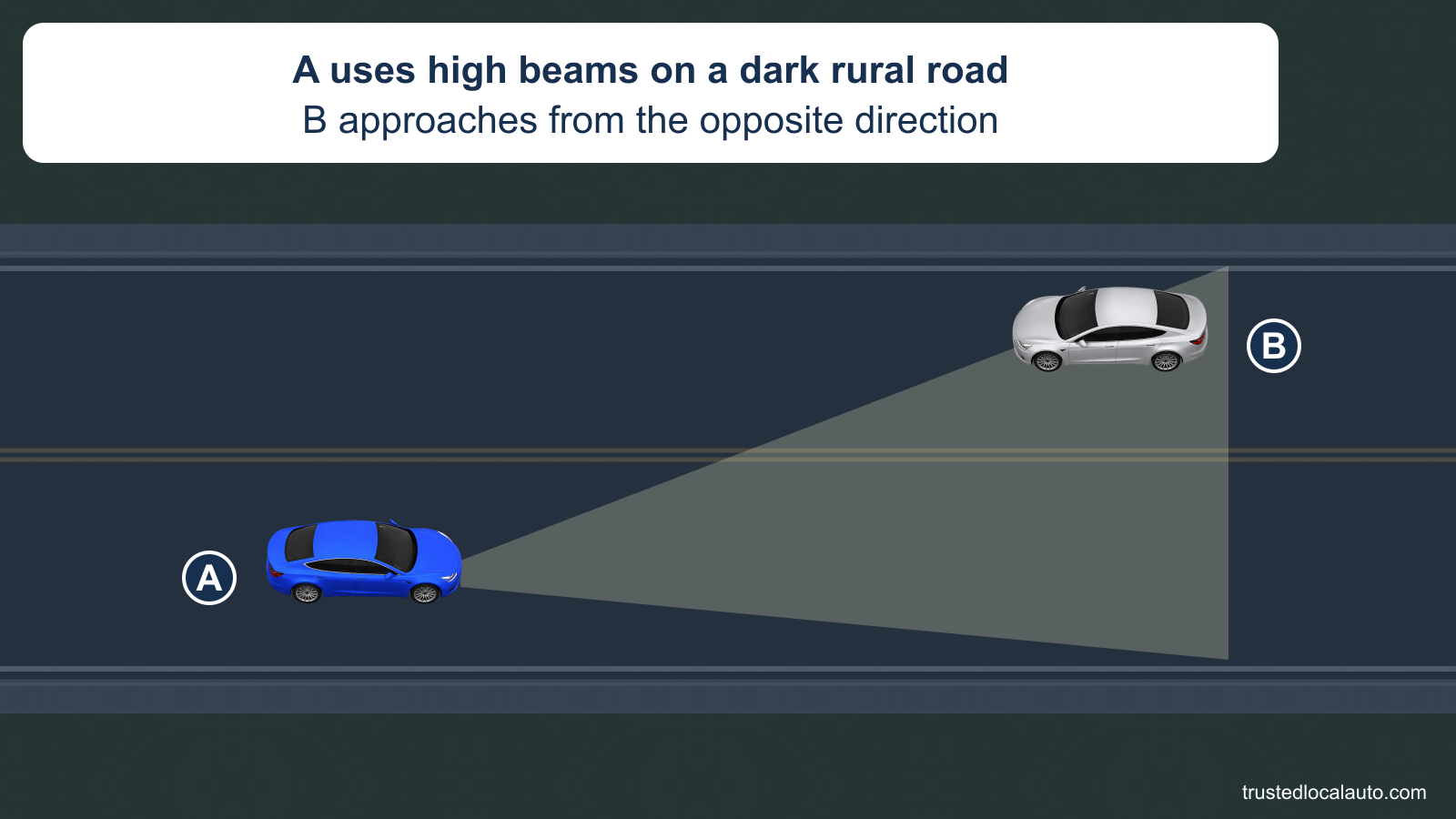
Correct answer: When the car is 500 feet away.
Why
High beams help you see farther on dark roads, but their glare can blind another driver for several seconds. The manual tells you to use low beams when you meet or overtake a vehicle within 500 feet, in cities and towns, and on curves to the right where your lights would shine into oncoming cars. Do not flash your high beams to warn a driver who does not dim, because the flash can distract that driver and cause a crash.
Verified against Tennessee Comprehensive Driver License Manual · Driving at Night — Dimming your lights · p. 88, 59
Is this question correct and clear?
Continue learning
Related Tennessee questions
- Your car does not have antilock brakes. On an icy road you brake to stop, and the wheels lock. The car slides straight ahead and does not respond when you steer. What should you do?
- Your car and another car crash in the center lane of a busy interstate. Both cars can still be driven, but the other driver is badly hurt. What should you do?
- It is 2 p.m., and a steady drizzle makes you run your windshield wipers all the time. You can still see well. What does Tennessee law say about your headlights?
- At dusk on a two-lane road, a deer steps into your lane close ahead. A car comes toward you in the other lane, and you cannot stop in time. What gives you the best chance of avoiding serious injury?
- It has not rained for two weeks. As you drive, a light rain starts to fall. When is the road likely to be the most slippery?
- After a heavy storm, water flows across a low spot in the road ahead. It looks only a few inches deep, and a pickup truck just drove through it. What should you do?