
Regulatory, Lane & Parking Signs
This sign faces you as you reach the end of a side street. Which way may you turn onto the cross street?
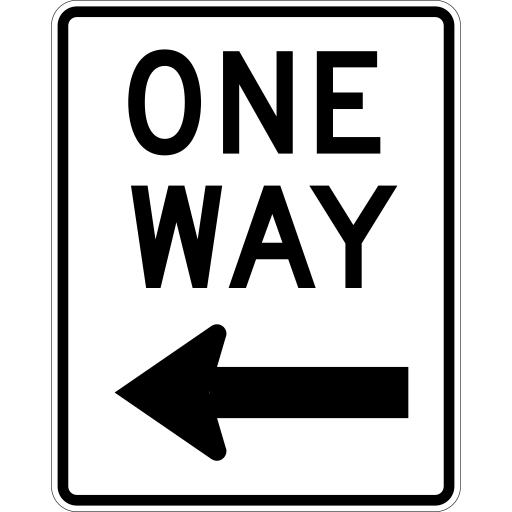
- AAgainst the arrow, because the arrow shows where traffic comes from.
- BIn the direction the arrow points, with the flow of traffic.
- CLeft or right, as the sign is meant for drivers already on that street.
- DYou may not turn onto it; go straight across instead.
Show the answer and the explanationHide the answer
Correct answer: B. In the direction the arrow points, with the flow of traffic.
Why
The vertical ONE WAY sign has the same meaning as the horizontal one: traffic on that street may travel only in the direction of the arrow. When you turn onto a one-way street, turn so that you travel the way the arrow points. A turn the other way puts you head-on with traffic. Do not confuse it with the DO NOT ENTER sign, which tells you not to enter a street from where you are.
Why the other answers are not correct
- A. Wrong: the arrow shows the direction that traffic travels on the one-way street, so turning against it means driving the wrong way.
- C. Wrong: ONE WAY signs at the corners face drivers who enter or cross the one-way street, so the sign applies to you.
- D. Wrong: the sign does not close the street to you; you may turn onto it in the direction of the arrow.
Verified against Manual on Uniform Traffic Control Devices for Streets and Highways, 11th Edition with Revision 1 · Section 2B.49 ONE WAY Signs (R6-1 and R6-2) · p. 155
Practice this sign with the other questions of your state permit test.
Choose your state practice test