
Practice question, Question 1 of 65
Passing target: 80% (52/65)
You are 300 feet from the intersection where you will turn right, and cars are behind you. When must your turn signal be on?
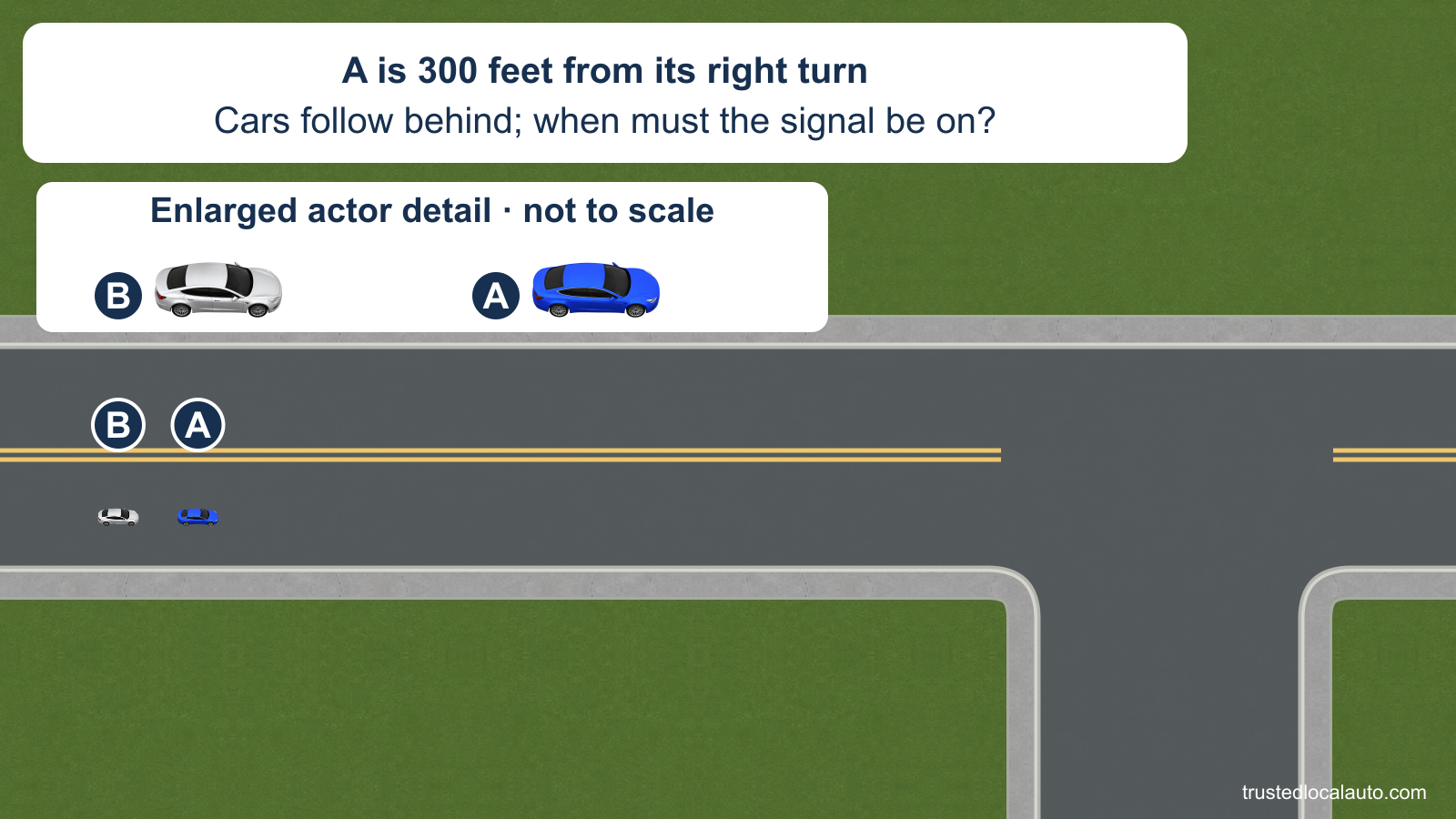
Correct answer: For at least the last 100 feet before the turn, without a break.
Why
Your signal tells the drivers behind you why you slow down, so it helps prevent rear-end crashes. If you will turn just after an intersection, start to signal when you are through the intersection, so that drivers do not think you will turn at it. If your turn signals do not work or are hard to see, use hand signals.
Verified against Wisconsin Motorists' Handbook · Turn signals · p. 25
Is this question correct and clear?
Continue learning
Related Wisconsin questions
- The turn signals on an old pickup truck ahead of you do not work. The driver puts the left arm out of the window, bent at the elbow, with the hand pointing up. What does this signal mean?
- On a two-lane road, a car behind you moves into the oncoming lane to pass you. What should you do?
- On a two-lane road, the car ahead of you has stopped with its left signal on, waiting to turn left. The road has a paved shoulder on the right. Which statement about passing it is correct?
- At an intersection, two lanes are marked for left turns. You are in the right one of the two left-turn lanes. The street that you turn onto has three lanes in your direction. In which lane should you finish the turn?
- On a two-lane road, the car ahead of you has stopped with its left signal on, waiting to turn left. The road has a paved shoulder on the right. What does Wisconsin law allow?
- You are in the left lane of a two-way street with two lanes each way. You will turn left onto another two-way street with two lanes each way. No signs or markings show a path. Which lane should you turn into?